Thursday, October 3, 2013

Green Pass Campaign: Generating A Player Character & Realm

https://s3.amazonaws.com/ksr/projects/464611/photo-main.jpg?1365559181I've decided to call my strategy-RPG campaign "Green Pass", since that's the boundary feature between the Kingdom of Durnovar and the Undying Lands. I'm using the ACKS (Adventurer Conqueror King) ruleset to handle high-level features like economics, armies, and important leaders. For exploration-oriented play, I'm adding a number of new subsystems written for my Fantastic Frontiers project, to test them out. I'll just need to add a few mechanisms to link aspects of the exploration game to the kingdom-building game, and then everything should be fully integrated.

The general concepts in this system should be pretty familiar to anyone who's played a normal RPG. The main difference here is that instead of controlling a single person, you're controlling an entire collection of leaders and all their possessions. Rob Kuntz (one of the original Lake Geneva GMs) calls this a "stable of player characters". In effect, you'll have a whole set of different alter egos that operate on multiple scales of gameplay, from neophyte heroes to high-ranking lords.

To join the campaign, it's necessary to create both a ruler and a realm. To provide an example for the benefit of anyone else who'd like to play, I'll do an example of the character/realm creation system for high-level play. This is using material from the last section of the ACKS rule book on starting a high-level campaign, as well as the draft of the soon-to-be-released Domains at War rules for military campaigns. The basic rules cover mostly conventional RPG play, but the newer releases cover strategic and tactical wargame play.

The ruler of your realm is your top-level player character, who will start with 310,000 experience points. This is enough to put most character classes in the vicinity of level 8-10, which is pretty powerful in a system where maximum level is 14. The default character creation method is 3d6 in order yielding modifiers limited to the +/- 3 range, which results in characters who have relatively few ability bonuses and force you to play with some unconventional stat combinations. It does allow rolling five different characters (to pick the one you like best), and it lets you roll a 7th "wild card" roll that can be swapped in to replace (for example) any horribly low stat that would otherwise ruin a character.

After rolling five characters, two of them look promising. One is a really good mage (INT 17 and CON 16, both +2 stats), with a wildcard of 14. I could use that to replace either DEX 8 (a -1 penalty) or CHA 11. Charisma is really important for a leader, so getting a bonus there is appealing. The other is a decent cleric (WIS 15, CHA 15, and CON 15, all +1 stats). To compare these options, let's look at the options they'd offer for realm-level play. I'll assume you're already familiar with how they work in man-to-man combat, based on some prior RPG experience.

Fighters (and fighter subclasses like paladins, etc)
Bear Cavalry Image
These characters are built tough (in a game system that makes most characters very fragile and prone to death!) and they make excellent leaders on the battlefield commanding armies. ACKS has a generous rule for cleave/sweep attacks, so a fighter can do a tremendous amount of damage in massed combat if provided with adequate healing and potions.
  • Best for: Building large armies and commanding them in the field
  • Also good for: Economic play involving realm expansion
Mages (and arcane hybrid classes)
These characters are the classic "mad scientists" of the fantasy world, building great laboratories and using them to collect monsters (and magically engineer freaky new ones). They can mass-produce magical items for use by army leaders, develop powerful new ritual spells that can turn the tide of a battle, and deploy constructs like golems and bizarre hybrids (think: this). They play a support role in realm-building, in some sense, but a very potent one.
  • Best for: Crafting items, new monsters, and powerful spell rituals
  • Also good for: Economic play (especially when chaotic-aligned, since many monsters are chaotic)
Clerics (and cleric subclasses)
2013-02-16-pope-memePriestly characters rule as a convenient combination of fighters and mages. They are very good at the administration of large realms, and can also draw on the devotion of their followers to create magical items, though not on quite the same scale of production as mages. They also have ritual spells, but only up to 7th level, not 9th. Unlike mages, they don't naturally attract monsters, and they can't create constructs or design hybrids.
  • Best for: Growing a large, prosperous realm
  • Also good for: Crafting a few powerful items
Thieves (and rogue-types like assassins, etc)
http://cdn.memegenerator.net/instances/250x250/32026068.jpgUnlike the other three classes, rogues don't rule populations at all. Instead, they form criminal guilds that function as a multipurpose criminal element, infiltrating everyone else's realms. Rather than having a large number of 0th-level soldiers, they have a small number of higher-leveled characters who can be assigned to various covert activities like assassination, burglary, treasure-hunting, and information-gathering. They can also earn a living by functioning as honest traders, but that's not as much fun. These underlings tend to level up quickly, letting a rogue effectively control a large number of lower-level player characters. If they can elude the law, that is.
  • Best for: Causing mischief and mayhem
  • Also good for: Causing more mayhem, for profit
It's important to realize that this only determines starting rulers. It's quite possible for your rulers to hire henchmen (who essentially develop into additional player characters) from any other class and help them to level up, giving you access to all four types of gameplay. There's also a natural encouragement for cooperative play (within your own kingdom, or with an ally): cleric-leaders bankrolling and mustering armies, fighter-leaders commanding them, mage-leaders arming heroes with enchanted gear (and showing up to toss around fireballs), and thief-leaders sneaking into enemy fortresses to unlock the gate and set fire to the keep.

With that in mind, I'll actually pick the cleric character, since that gives me a chance to show off a balanced style of development focused on realm-building. With 310,000 exp, a cleric can start at 10th level. This provides access to all five normal spell levels of divine casting, although it will take one more level to unlock ritual spells.

Each starting ruler get a 240,000 gold piece budget to develop a realm. This realm-creation budget can be spent in the following areas:
  • Purchasing a collection of normal equipment, which can be basic stuff like weapons and armor, but also entire caravans of wagons, or fleets of ships, to send off on trade missions.
  • Purchasing magical items, or alternatively, the formulas to make new magical items in a workshop. You can either spend 100,000 to have a guaranteed set of lots of diverse magical gear (enough to equip you and a few henchmen), or spent lesser amounts to roll randomly a certain number of times on the treasure table. I opted to spent about 40,000 gp and roll randomly!
  • Recruiting mercenaries (for an army), high-level henchmen (to lead your army or help you go adventuring), and various other support hirelings. Henchmen can eventually become alternate characters with their own domains in your realm ("vassals"), allowing you to get wildly rich in the classical medieval pyramid scheme.
  • Building a stronghold (keep, castle, tower, wizard's sanctum, etc), and controlling an area of land ranging between 1 and 16 hexes, depending on the size of your stronghold. This land will automatically be populated with peasant immigrants, and you can invest money to further develop it and attract a larger population.
I'm going to develop my cleric as a land-holder with a castle and some mercenary troops. Although 240,000 gp seems like a lot of wealth, it gets eaten up quickly by a major building project! My intention is to spend about 40,000 on equipment (including a large sailing ship for trade), another 40,000 for magic items and crafting formulas, and then everything else on building a sizable fortress and an army. This won't be an army that can challenge entire kindoms, but it should be enough to put most other local barons to shame.

Since this post is running a bit long, I'll put the detailed breakdown of expenses in a following post.

Wednesday, October 2, 2013

Living Fantasy Campaign Setting: Proxima, A Time-Lost World

This is my proposed setting for an integrated fantasy campaign that combines multiple games to simulate a persistent world. The idea is that various game outcomes will be written together into the fictional history to provide a narrative thread that connects them. Here's a look at the world I'm designing using Hexographer's mapping functions. I think they do a good job of capturing the feel of the old Gazetteer maps.
Background
In the forgotten antideleuvian past of our own world, mighty empires fought endlessly in the pursuit of supreme power. With armies and mystic arts, they sought to conquer and enslave the lesser tribes of men, to vie with one another for dominion, and to challenge the Decrees of the High Heaven. By their arrogance, they earned the wrath of Heaven and a Word of Doom was pronounced against them.
Divining that a time of calamity was near, the ruling city-states of the world consulted their priests and oracles for guidance. Too proud to repent, they instead sought to escape Heaven's fury by fleeing across time, transporting their entire civilization from dawn of history into a distant future age when they imagined Heaven's Throne itself might well be overthrown and they could rule an unwatched cosmos as gods themselves. Their cities faded away into arcane mists that carried them between-times, even as the seas rose and the land was torn asunder to sink beneath the waves.
But even across the span of aeons, the Word of Doom resounded. Each of the four great civilizations found itself beset by troubles in new age.
The Lost Continent of Mu found itself in a trackless all-sea, and sank to the same doom as the one it had fled. Its halls and temples became the desmesne of fish and sea monsters, choked with corals and weeds. Rumors still abound of great treasures miles below the water that will never again been seen by human eyes, the unclaimed hoard of the deep.
The Cities of Lemuria shifted into a sweltering jungle of creeping vegetation and savage beasts. The battle to hold the forces of nature at bay raged for a generation, then ended in defeat. The survivors fled to establish an autocratic state on the great landlocked Meridi Sea, ruling the southlands with a fist of hard obsidian.
The seafaring Ports of Atlantis emerged perched precariously on a volcanic archipelago. Over the years, fire from the skies rained down on them, and ash buried them. The survivors sought refuge in the small island continent of Beringia, seeking employment as court astrologers and alchemists, each scheming to amass personal wealth and authority.
The twin Cities of Hyperborea were cursed to arrive in a desert wasteland, swallowed by shifting sands and besieged on all sides by hostile races of bestial men that sought to plunder them. Even as the guardians of the cities seemed sure to obtain the final victory by dint of magical arts, they were betrayed from within by those who saw the chance to cast out the old rulers and found a new dynasty. Those who allied with the beastmen were numbered as 13, and used their craft to obtain an immortality of sorts. They aged but slowly, and drained the lifeblood and souls of their thralls and prisoners to prolong life indefinitely. The Undying founded their own realms around the rim of the great desert, and bent ever more powerful servants to their whim: great wyrms, monstrous legions, and the fiends of the underworld.
The time-eddies left by their escape from antiquity would also ensnare other victims even after the cataclysm of quakes and floods. Many adventuresome sailors of the ancient world found themselves similarly lost in time, trapped in the shattered world of Proxima far from their homelands. Forced to endure in unfamiliar territories, they founded kingdoms that were not under any Heaven-spoken doom, but free to seek their own fates.
This is a map of the world of Proxima, a supercontinent ringed by a vast ocean. You can see the locations of the above rogue's-gallery of evil nations, as well as other features. Mountain ranges partition the continent into  three "basins" (plus an inland sea) which are effectively isolated ecoregions. The developed area is in the north-west, adjacent to Hyperborea.

Plate tectonics run amok!
Zooming in a bit, we can see the sinister Boreal Basin, home to the lands of the Undying. This whole area is rife with virtually every horrible fantasy species you've ever met, from goblins up to giants. These aren't the people you want as your new neighbors. Durnovar and Chukchi are the two centers of non-horrible civilization in the area. Think of Durnovar as the roughly "European" one, and Chukchi as the roughly "Asian" one. (Well, North Pacific one, at least.) Winlend is a prosperous sea-kingdom, and a reliable sponsor of all the heroic activities that you would expect in a proper fantasy world. Currently it's interested in expanding through both colonization projects and military campaigns, and doesn't mind subcontracting that work out to professional adventurers with delusions of manifest destiny. That's you!

The west side of the northern hemisphere, because I'm Eurocentric like that.
Let's look even closer. Here's a run-down of local geopolitics. For sake of reference, each of those hexes is pretty big, roughly 200-300 miles across; France would take up one of them.
  • Elysion is Dunovar's fingerhold on the mainland that extends as far as the mountain boundary; like Greenland, its name can be chalked up to a deceptive marketing campaign. It's located uncomfortable close to lots of geopolitical trouble in the Boreal Basin. The easiest way through the mountains is Green Pass, a fortified mountain road under the control of Durnovaric forces for the last 70 years. Periodically Durnovar tries to send an army through to attempt an offensive campaign (Napoleon-in-Russia style), but it rarely goes well. And periodically the Undying launch counterattacks over or under the mountains, using flying, climbing, or tunneling monsters as transportation; if they every got really organized, they'd be a serious threat to the inhabitants of Elysion.
  • Winlend is a sea-kingdom with the prosperous port of Durnovar at its southern tip. It's the late Greco-Roman Empire of its era, with lots of great accomplishments but also at risk of overextension. This is a great place to conduct mercantile activity of all types, either running short weekly supply runs to Straddleport, monthly runs to Lockhaven, or even a lengthy trip to the distant western realms of Beringia for more exotic fare.
  • Cascadia is a vast wilderness packed with weird stuff to discover; it's a pocket-size fantasy version of North-America. It's got valuable land ripe for the taking, making it a prime colonization target. Of course, valuable lands aren't necessarily empty or safe.
  • The Niobraran Desert shoreline is home to lots of pirates. Because... pirates. They're raider types who send up galley ships to pillage coastal settlements. Durnovar could probably crush them, if it weren't preoccupied with fending off the Undying legions to the east. As it is, they're building a criminal empire around trafficking with one another in slaves and stolen goods.
With proposed locations for various Hex Crawl Chronicles maps.
What can adventurers do in this world?
  • Manage feudal domains and realms in Elysion, and protect them from invaders.
  • Construct and deploy fleets of trade ships, to earn extra income. Arm them to fight pirates!
  • Participate in foolhardy military campaigns against the Undying, and hopefully survive to report about the lands beyond Green Pass.
  • Explore and colonize Cascadia by sending out small expeditions to scout the region, ally with friendly locals, eliminate threats (personally or with hired armies), and build castles and towers to defend conquered lands.
  • Do a little light recreational dungeon-delving on the side, if the opportunity presents itself.
 Next up: An example of character and realm generation.

Monday, September 30, 2013

Strategy RPG Options

For a year or so, I've been thinking about creating a campaign that joins together several different levels of medieval-fantasy gameplay. As I mentioned a year ago, this idea dates back to the proto-RPG scene in the 1970s, where it wasn't unusual to mesh together a hodge-podge of different game systems to simulate the operation of a small kingdom in a pseudo-medieval world. Most of these early projects were disorganized and poorly recorded, although a heroic amount of editorial work by Judges Guild ended up saving enough of Dave Arneson's First Fantasy Campaign to preserve the basic concepts for posterity. The result is simultaneously both a fantastic mess, and yet gloriously visionary.

This sort of project mostly collapsed in favor of episodic single-session roleplaying centered on one particular element of the fantasy kingdom: the great deeds of individual heroes. This style of play was necessarily somewhat limited by time constraints and the need to keep all players engaged at once. In the 70s, play-by-mail games were pretty common and face-to-face meetings were major events. So it seemed "normal" to have players (mostly hardcore wargame hobbyists) spend most of a month slowly designing their private castles and armies. But during the peak-fad years of the early 80s, game audiences shifted toward younger players and more fluid groups with a steady rotation of inexperienced players. Only the dungeon-delving subgame could really meet the needs of that social environment.

Trying to reintegrate the kingdom-management game with the heroic-adventure game to create an ur-RPG is difficult. RPG heroes tend to rapidly accumulate power in ways that totally circumvent the need for participation in normal society, zooming from chumps to demigods in a matter of months through the power of level-grinding. Any realistic simulation of the ways in which actual medieval nobles worked to accumulate their own little fiefdoms would get in the way of your standard high-fantasy plotline!

What I'd really like to find is a fully procedural (i.e., based on just-in-time dice rolling, not purchasing a "campaign setting") strategic system that will
  • Generate a reasonable-looking random world environment
  • Allow players to run a small kingdom or duchy, making meaningful decisions that balance off the usual 4X priorities
  • Field armies to fight miniature battles when the sides are evenly matched, or quickly simulate the outcome of those battles if they look lopsided or otherwise boring
  • Allow for personal development of a few named leaders of those kingdoms, through the traditional "treasure-seeking and monster-slaying" RPG
That wouldn't necessarily mean doing anything beyond the game sessions we've played in the past year or so. It would just involve tying together different games that were formerly independent. So the build-your-own miniatures battles would be replaced by battles to resolve events in a dynamic world, or short one-night RPG excursions would yield mature heroes who could live on as captains in the armies of those kingdoms!

Here are a few products on the market today that try to add the strategic layer back into games, and my assessment of each of them.

Renegade Crowns This is notionally a product for Warhammer Fantasy, but it's virtually system independent. It uses a vast array of tables to generate an entire region of random fantasy principalities, full of cruel greedy despots. The book is of high quality and is full of flavor and dark humor. It really performs only one function, however -- world-building. There are no rules for actually managing the militaries or economies of those political organizations. It's essentially a setting-design workshop for a GM who wants to create plot-hooks for a high-level campaign that revolves around politics.

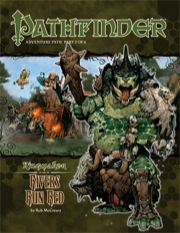
Pathfinder Adventure Path #32: Rivers Run Red (Kingmaker 2 of 6) (PFRPG)Kingmaker This a Paizo adventure path which adds both a lightweight kingdom simulator and a set of mass combat rules. (The rules are freely available as open-source content though the SRD, using the links provided.) The implementation is minimalist, but has extremely high production standards, including a beautiful customizable city map. The focus of simulation is towns and the buildings used to develop them, rather like cities in Civilization. This is essentially a self-contained mini-game which uses abstracted resources (BP) and consists of balancing three competing priorities represented by single-value statistics (Stability/Loyalty/Economy) in city development. Each structure either generates income or improves a statistic. The rules are revised and indexed in the recently-released Ultimate Campaign sourcebook.

Birthright This set of rules was originally developed by TSR for second edition D&D, then abandoned after the takeover by WotC. Unofficial rules have since been developed for 3e by a volunteer online community. It's highly setting-specific (based on the concept of magical bloodlines), and some central game aspects would be hard to adapt to a new setting. Battles can be resolved either through direct dice-rolling based on relative strength, or by a detailed tactical battle. Naval units are nicely differentiated, and heroes can join the battle directly by treating their adventuring parties as units.

An Echo, ResoundingAn Echo, Resounding This is a system very similar to Paizo's, but with less emphasis on a single settlement and more on the surrounding environment. Here the stats are Military/Wealth/Social, but they work in much the same way. It supports a unique Asian-flavored setting, and lots of well-written examples of how to use domain management and prepare a map. It's weakly-linked "minigame" that sits on top of an existing campaign, allowing players to make a few domain-scale decisions at the beginning/end of each night of standard RPG play. It's the work of a single author, Kevin Crawford, and yet in many ways it manages to be quite competitive with Paizo's rules. But while Paizo is more interested in 3e/OGL compatibility, this set of rules is obviously designed to interface with 1e/2e version of D&D. (It advertises compatibility with the Labyrinth Lord retroclone, but has so few linkages to other rules that it could be used for anything pre-3e with only minor changes.)

Adventurer Conqueror King SystemAdventurer, Conqueror, King (ACKS) This is the "crunchiest" system on the market, with emphasis on realistic demographics and economics. It's built on top of the old Basic rules, plus a few imported ideas like a 2e-style THACO system for hits, as a sort of alternate-universe version of the rather-different endgame in the Rules Cyclopedia. It's really working hard to provide as much detail as possible, and as a result, it would be hard to run without a spreadsheet to keep track of all the information involved. It's an approach that heavily emphasizes stronghold-building and merchant-trading operations which are absent or highly abstracted in other systems. In that sense, it looks less like a post-Sid Meier simplification-of-design approach ("reduce everything to block granularity and single functions") and more like a 70s-era wargame. You can pretty much design a castle from the ground-up, using grid paper, and figure out exactly how much it costs and precisely how many troops can be garrisoned there. There are extensive supply and command rules. And so forth.

All of these systems look interesting, but I think my inclination is toward ACKS for a few reasons:
  • Most other systems assume that you start with a long RPG campaign, and pin the strategy game onto the end of it. I'm too impatient to run a long campaign of RPG modules before getting to "the good stuff" with armies and castles. And in any event, I know more about wargames than I do about RPGs.
  • The majority of systems above involve a party of adventurers pooling resources to run a single kingdom, which each party member playing a specific role. I'm more interested in a quasi-competitive game in which each player gets a separate kingdom to run. ACKS lets you fill out your own private roster of vassals and henchmen, giving you your own team of heroes (at various stages of career development) to run all at once.
  • There's a good deal of research behind the rules, so that (for example) the duration of sieges in the game will be very similar to the duration of historical sieges, or (for another example) the fraction of your population in cities will be very small compared to the number of rural serfs required to support them. I'm a simulationist at heart, and I love knowing the exact number of peasant families in my realm!
The biggest defect I see in ACKS is the absence of a good exploration component to the game. That is, you just clear a sufficient number of hexes, roll dice for the "quality" of your land, and there's really no other inputs than the dice. In particular, it doesn't make sense to pay any attention to geography when laying out your domains, since geographic features make no difference to your result. A kingdom in the mountains works exactly the same way as an ocean port.

So I'm thinking that I'll use the ACKS rules, but add in a subsystem to randomly generate a terrain map (or really, borrow it from my own FF project for some playtesting!) and then reference the map to determine the value of a domain that includes certain hexes. This makes it definitely worth searching around for special features (lakes, mines, timber, that sort of thing), rather than just rolling and then inventing those details after the fact to explain the roll. I want to recapture some of the feel of Imperial Starfire, where you could roll up an amazing binary-star system with three habitable planets at maximum mineral value and a tidelocked moon!


Saturday, September 28, 2013

No Games This Week

Our regular family schedule this week was pre-empted by a new arrival!

Mary Olivia 'Molly' Hamilton, born 9/26/13

Wednesday, September 25, 2013

The Rise And Fall Of Computer Strategy

Game design philosopher Chris Bateman explains why, if you're an NT in the Meyers-Briggs taxonomy, you probably think that games have gone all downhill since the 90s:
Because the Rational temperament is associated with programmers and game designers, early videogames were extremely influenced by Strategic play. Early mainframe games in the 1970s , such as Star Trek (Mike Mayfield, 1971), Adventure/Colossal Cave (Will Crowther, 1975) and Dungeon (Don Daglow, 1975) and its spiritual descendent Rogue (Toy, Wichman and Arnold, 1980). Many early games were influenced by the tabletop wargames (and role-playing games) of the 1970s, which were also great examples of Strategic play – providing complex play resulting from many different rules and options.
In the 1990s, turn-based strategy games raised Strategic play to a new level with games such as Civilization (Microprose, 1991), Master of Orion (Simtex, 1993) and the X-COM series (Mythos Games et al, 1994 onwards). Additionally, strategic role-playing games such as the Heroes of Might and Magic series (New World Computing et al, 1990 onwards), and point and click adventures such as The Secret of Monkey Island (LucasArts, 1990) made this decade the golden age of Strategic play for many people preferring this play style.

This screen represents hundreds of hours of my life.
Sadly for players preferring Strategic play, the arrival of the PlayStation in the mid-90s marked a change in the focus of the videogame market. Until this point, players favouring Strategic play were (arguably) in the majority, and the bulk of the games being made appealed to these players in some way. But a new era was arriving in which effortless 3D graphics opened the door to a wider market. The Strategic player was about to go from being the key audience for videogames, to being a strong but diminished niche market. 
This change was to mark the end of the commercial importance of adventure games, and a gradual narrowing of the importance of turn-based strategy games which today support very few viable franchises, and maximum audiences of no more than 2 million units (while other types of games were able to pull in maximum audiences of 8 million units during this time). Today, Strategic play in isolation is a commercial backwater, although many successful games support Strategic play along with other play styles.

Saturday, September 21, 2013

Next Up?

Next up, for me at least, had better be the birth of my daughter, who's already three days late.

That probably means I won't be sitting in on any Saturday games next week. If I do, I'll be leaving a very grumpy, desperate, and immobile wife at home. I anticipate taking a vacation for a few weeks from playing much of anything.

The next project will probably involve trying to come up with an ongoing fantasy kingdom simulator that can function as a strategy-RPG wrapper for miniature battles. I want something that functions like the Starfire strategic system, to tie together some single-night fantasy battles. Already have plenty of ideas. Don't have nearly enough time. As usual.

Meanwhile, I've invested in some additional supplies and game components for a solo playtest of the FF rules. I'm still working out some details for the territory-control subgame that involves garrisoning trade routes and unique sites. But I already have a working mock-up for the setup and the encounter tables. At this point, my greatest concern is that the rules are getting too bloated and need streamlining.

MEK OP Game Night: War of the Ring

With two simultaneous Warhammer games going on at once, and my wife home being unhappily pregnant, there weren't many players left over for board games. I set up War of the Ring anticipating we might have a few new players, but ended up in a one-on-one game against Walley. He elected to play the Free Peoples again, and this time the game was much more even.

Shadow opened by massing against Rohan. Cards on the table from both sides turned the northern front into a stalemate, and very little happened there through the night aside from periodic reinforcement and an Easterling strike on Dale. Instead, the game featured a very methodical grind through Rohan and on into Gondor.

The Fellowship elected to move south through Isengard. This slightly longer path might have made the difference between a victory and a defeat, given the closeness of the result. As it was, the slightly greater danger of being hunted by orcs out of Orthanc was mostly negated by poor hunt rolls early in the game.

Going into what would almost certainly have been the penultimate turn of the game, Shadow was still missing three victory points, and the Fellowship (guided by Legolas(!) and Pippin(!!)) was only four steps from Mount Doom. Minas Tirith had crumbled under multiple assaults, taking Gandalf, Aragorn, and Boromir with it. An enormous number of non-hunt action dice gave Shadow just enough resources to take apart both Dol Amroth and Lorien, as the clock ran down.

Neither siege would have succeeded without the perfect set of Shadow event cards. The siege of Dol Amroth featured Grond, Hammer of the Underworld, providing a 3 round battle.


Meanwhile, the siege of Lorien was supported by the balrog of Moria, good for some extra rolls pre-battle at 4+.
SFA3 Balrog.gif
Why have you forsaken me, Google image search?
*cough* Let's try that again.
OK, that's better. All is forgiven.
And the Witch King made an appearance at both. So at least everything closed out in suitably epic style.