Showing posts with label design. Show all posts

Monday, October 28, 2013

D@W Campaigns: Possible House Rules

To summarize the previous post about why the Campaigns rules in Chapter 3 were difficult for me to use:
First, too many low-success recon checks slow down game play, and so the game over-invests in maintenance activities that don't involve players. Second, the modifiers that are present skew the dice roll results strongly toward one end of the spectrum, making them too predictable.
Looking at the table of recon modifiers, they fall into three general categories:
  • Symmetric modifiers that affect both armies equally (distance, size, terrain)
  • Asymmetric modifiers that affect just one side (magic, air, spies)
  • Anti-symmetric modifiers that affect both sides equally but inversely (leadership, screening, familiarity)
For my own reference tables, I'll probably rearrange the modifiers in this order.

In principle, size and terrain could be asymmetric, but often they are not because both sides will seek to use them in similar ways. If there's forest around, both sides will hide in it. In a balanced game sides have similar sizes, and if there's an advantage to breaking down into sub-armies, then both sides will break down. In particular, they tend to both result in negative modifiers that make the majority of rolls almost useless (nothing but a 10+, or 11+, or even 12+ will find).

My first proposal is to turn the size modifiers into range modifiers, instead of dice roll modifiers. I would also make them explicitly symmetric, so that both the searching army and the opposing army would get the modifier of the smaller of the two. Then negative modifiers in these categories would simply suppress any long-range dice rolls involving small forces! The base range would be 3 24-mile super-hexes (that is, 12 6-mile hexes), and would range between 1 super-hex (for a -2 modifier with the smaller side under 600 troops) up to 6 super-hexes (for a +3 modifier with both sides over 72,000 troops).

To me, it makes sense for this modifier to be symmetrical and to affect range. Not only is a small force harder to find until it gets close, but it also can't spare as many soldiers to function as deep penetration scouts, and so the ones it can spare will cover a proportionally smaller area.

Also, one of the stranger effects of the current approach is that it is much easier to get a count of the number/type/strength of units in an army when that army is large, instead of when it is small. That seems backward, in that a small army should be easier to scout once it is discovered. That is, if you only see a couple hundred troops, it's easy to conclude "They're all orcs!", but if you see a hundred-thousand troops, all you can say is "The battalion closest to me looked like orcs, and beyond that, they were just an endless field of countless helmets and banners". Locating and evaluating an opposing army are distinct functions, and making size into a range modifier emphasizes their independence.

My second proposal is to remove the distance-between-armies modifiers from the roll itself, and allow it to only affect the recon result indirectly through the Degree of Success results. In effect, this modifier is currently being applied in two ways, since it both reduces success chance (on the roll) and then also changes what it means to have a "success" (on the results table). This is creating unnecessary overhead. If you want range to have strong penalties, it would make more sense to just confine it to one of these two places but intensify the consequences. That is, you could either double the roll penalty, but collapse "Proximity of Armies" to a single row, or else remove the roll penalty but make the variation with proximity more severe.

I think I like the latter option better, although I think distance effects might be too strong already, so the best option might be to just drop distance modifiers to the roll entirely. The advantage of keeping it on the Results table (instead of the roll) is that it doesn't create the too-frequent skew toward "Catastrophe" results.

The benefit of both proposals is that they eliminate effects that tend to push the 2d6 roll out of the balanced range 2-12, and skew it strongly toward one end. This increases the uncertainty of results, since players will have fewer expectations about whether they should be routinely falling on one end or the other. Instead of one or two reasonable outcomes, the full spectrum of five outcomes (from Catastrophe to Major Success) will seem plausible in most cases. If they are skewed, it will mostly be on account of hidden variables, like which side has more cavalry or better leadership.

This makes the Catastrophe result meaningful again! Instead of showing up over 50% of the time due to stacked negative size/distance modifiers, it will again become something rare and exciting, as players will really be unsure whether they have a Major Success or a Catastrophe.

Wednesday, October 16, 2013

How Twisty Are Rivers?


The River Jurua, in the Amazon Basin.
The objection has been raised (Hi Kyle!) that my attempt at river generation from a random walk is producing too many twists and that the rivers should be straightened out. I should note that the
example I posted was more twist-laden than a few other attempts I made, and it's quite possible to create a fairly straight section of river as well. Still, let's take a little time look at how to evaluate river bends in terms of their realism.

There are really two relevant parameters for classifying the meanders of rivers: sinuousity, and curvature radius. The former tells us how much curvature is present, and the latter tells us the distance scale on which that curvature exists. Most river valleys are relatively straight or gently bending, and so it is only the river itself that is subject to meandering within the valley.

Here's a plot of river sinuosity as a function of the local land gradient.
http://hydrosciences.colorado.edu/symposium/abstract_images/thumbnails/River_500x500.png
http://hydrosciences.colorado.edu/symposium/abstract_details_archive.php?abstract_id=183

Unsurprisingly, the more swiftly the river is descending, the less likely it is to meander. Values range between 1.2 and 2.4, with most rivers clustering above or below the value 1.5 in temperate zone. (The other cluster up above 2.0 consists of rivers in tropical rainforests.) The mean central angle of a river with a sinuosity of 1.5 is between 150 and 180 degrees. That's considerably snakier than a sine curve!

The mean radius of curvature is a little harder to explore, given more limited data. Here's the mean radius of curvature for the Colorado River:
http://www.utexas.edu/depts/grg/hudson/grg394k/studentprojects/may/mradofcurv.jpg
This is roughly in the neighborhood of 1 km, suggesting that river curves are features on the scale of about a mile or so. This is, naturally enough, the distance scale of the river valley bed.

The natural conclusions are:
  • Rivers curve quite a bit, frequently making the equivalent of near U-turns.
  • The distance scale for these turns is fairly narrow, in particular, much narrower than 6 miles, making these features wash out except on a lower-scale map.
From a game-map standpoint this creates a dilemma, in that a map with granularity of 6 miles can't really represent the lower-scale sinuosity of the river within its bed. It seems important to be able to explicitly locate places where land is surrounded on three sides by a river, for the sake of building your own Conwy! I hate to reduce the presence of bends to something abstractly "hidden" in a hex that shows a straight river, which takes away from the fun of trying to place a stronghold location on the hex map by looking at features on the map itself.

There's a similar problem associated with the difficulty of locating a "rock dome" suitable for a high castle. You can just say that any castle in the mountains is on a dome, but most castles were built on isolated hills and domes that were not otherwise close to other mountainous features. Moreover, since rivers don't go in mountain hexes, this would make it impossible to have an elevated castle on a river (like Conwy).

Thoughts?

Thursday, September 12, 2013

Fantastic Frontiers: Figuring Out Lairs

To begin, here's a little background. The basic historical game system I've written has three types of encounters that can happen, either when entering a new hex location or when resting overnight:
  • Settlements are found only for the first case, when entering a new hex. They consist of a village or encampment, which might form a trade agreement with you, but also might become hostile and threaten your existing trade routes. If they aren't conquered, they become a future source of...
  • Patrols, which are smaller groups of wandering natives. Patrols sometimes come from a settlement, but often are just random encounters with wild beasts (or magical ones, in a fantasy setting). Hostile patrols interfere with trade routes, and also launch constant attacks on your expedition until you eliminate them (or the settlement spawning them).
  • Events are miscellaneous problems or opportunities that either give you extra resources, or cause you to lose existing resources. I've tried to make them mostly positives, since "you lose your whole turn because of these two lines of flavor text" isn't much fun as a mechanic.
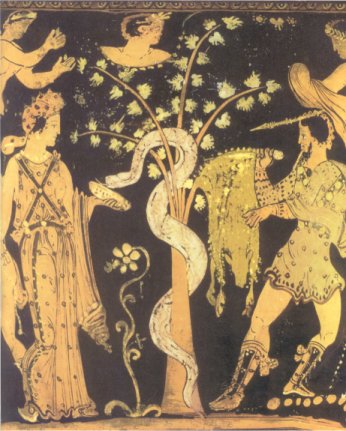
For the fantasy-mod rules, I'm intending to add a fourth type of encounter: monsters' lairs. These represent the kind of places that magical creates live, or guard the great heaps of wealth that you're trying to obtain. These have a fairly venerable pedigree in fantasy literature, dating back to the cup stolen from the dragon-hoard in the final act of Beowulf, or even to Jason's similar theft of the golden fleece from the Colchin dragon. A lair is essentially a fixed location with a permanent encounter that is resolved by a personal act of heroism.

The appeal of this is that it helps to better define the various leaders of the expedition (like Jason here) as monster-slaying heroes in their own right. It's a little anti-climactic when the solution to every wave of dive-bombing hippogriffs is to bring along dozens of archers to shoot them down. At some point, you want your little plastic hero figurines to go mano-a-mano with them in a dark cave, rather than beating them down with your mercenary budget. This also justifies the use of personal statistics (like strength and dexterity) which add color but otherwise don't have much effect on mass combat, unless your heroes are inflated to comic-book proportions.


But this creates a dilemma for me. There's some precedent for letting lairs be eliminated by encountering the monsters outside of them, where logically speaking it should be possible to bring your entire army to bear. For example, The Hobbit has its dwarven expedition encounter two lairs (trolls at the beginning, dragon at the end) and in each case defeats the monsters away from their home base. If this is possible, then it starts to feel almost mandatory to lure the monsters out of hiding. The right way to kill Smaug is always to trick him into flying over a squad of Laketown archers, and never to kill him in the fastness of Erebor.

This problem might be resolved by cost efficiency, for some monsters, where heroes who can survive the encounter can save the lives of the dozens of archers that would fall to a chimera's breath. But if you're getting reimbursed for casualties with a vast hoard of dragon-scale wealth, this stops mattering. (Archers are cheap, I'll just buy more!) This also obliges the player to follow the somewhat tedious approach of camping an army outside the front door of the lair for weeks, waiting for an ambush chance. Not especially heroic, and pretty boring for gameplay.

I'm torn between making lairs something like settlements (where they summon smaller monster patrols, but don't lose their own population in the process), or just making the monsters never emerge from them at all. The former feels ecologically silly (where are all these extra dragons coming from?!) But the latter feels static and non-threatening, and doesn't capture the kind of creeping dread that ought to arise from journeying too close to that ominous old cave with the smoke drifting out the front. I'll probably need to play it both ways, and decide which works better in practice.

Monday, September 9, 2013

Agency, Explained


Here's a pretty good summary, courtesy Subnormality's Winston Rowntree (h/t Cracked):
But you owe it to yourself to read the whole thing.


Sunday, September 8, 2013

Fantastic Frontiers: Cry Havoc, And Let Slip The Quantum Ogres!

A while ago, I read this interesting piece on the nature of freedom and player agency in a role-playing game. The basic question is whether it's reasonable to create a game that bends multiple choices to the same outcome, despite promoting the illusion that an alternate decision would have avoided that outcome. In this case, the outcome is a fight with an ogre, where the ogre just magically teleports to whetever location the players decide to go next. It prompted a number of helpful exchanges:
  • Here's a proposal to solve the perceived problem from Courtney Cambell ("C") which emphasizes the role of information in making choices substantive. It's not wrong to have a quantum ogre as the outcome of a meaningless decision. But once players obtain information that should make that decision meaningful (which a good game should always offer!), then we have problem if the information isn't actionable.
  • Here's some pushback, with a good set of comments by Courtney and Justin Alexander following it.
  • And here's a nice overview from Alexander Macris of some fundamental questions related to maximizing player agency, and making a game feel (and actually be!) "fair".
All of these pieces are well worth reading, although the immediate problem being addressed is one that arises in rather different forms in other types of games. For an RPG, the problem is that the GM is engaging in a sort of trickery that confuses the players and might violate an implicit social contract to be a "fair judge" in the adjudication of choices. But for a computer game, the problem is often that the mechanics of the game are hidden behind an opaque GUI that needs to be probed by trial and error, and might be too complicated or feedback-deficient to ever allow for pattern recognition.

In a board game, there's no risk of deception or obfuscation. Everyone knows the rules, and has access to identical information. Instead, the problem is hiding enough of the information to make the choice feel unpredictable at all, without becoming totally random.

To make this more concrete, consider the following advice from a friendly wizard:
There is [a way around Mirkwood], if you care to go two hundred miles or so out of your way north, and twice that south. But you wouldn't get a safe path even then. There are no safe paths in this part of the world. Remember you are over the Edge of the Wild now, and in for all sorts of fun wherever you go. Before you could get round Mirkwood in the North you would be right among the slopes of the Grey Mountains, and they are simply stiff with goblins, hobgoblins, and orcs of the worst description. Before you could get round it in the South, you would get into the land of the Necromancer, and even you, Bilbo, won't need me to tell you tales of that black sorcerer. I don't advise you to go anywhere near the places overlooked by his dark tower! Stick to the forest-track, keep your spirits up, hope for the best, and with a tremendous slice of luck you may come out one day and see the Long Marshes lying below you and beyond them, high in the East, the Lonely Mountain where dear old Smaug lives, though I hope he is not expecting you. (The Hobbit, 7.145)
A perfect wall of impassible mountains. How convenient!
Here we have three choices: goblin-infested mountains, Necromancer-infested shadowlands, and You-Know-What-infested Mirkwood. Gandalf is presenting this as a sort of Hobson's choice - "do as I say or die" - but presumably he doesn't have the actual ability to compel the dwarves to do anything. He's just giving information that makes the best decision blindingly obvious. Thorin and company are apparently getting railroaded by world-design into some spider- and elf-related encounters! At times, one starts to suspect that the suspiciously long chains of encircling mountains and forests in Middle Earth that turn Erebor and Mordor into fortresses with a single door are Tolkien's way of keeping his hobbits from wandering off to escape his carefully-prepped arachnid miniboss events.

This is a real choice, though, if a bit artificially discrete. Discrete choices often run into the problem of making the answer too obvious, which feels like a loss of player agency. In a novel, this might be a good way to comment on the nature of fate, but in a game, it takes an interesting decision and makes it boring.

So I've decided to take the whole "quantum ogre" idea and make it as literal as possible! A quantum wavefunction is typically distributed in a neat Gaussian distribution, rather than occupying a single point like a classical photon, or being spread out uniformly in space like a traveling-wave field. This is reminiscent of the three distinct encounter types in RPG-style games: random, pre-existing, and roaming.

In a game like last night's Runebound, we have pre-existing encounters printed out on little cards. They're essentially discrete quantum ogres, in the sense that no matter where you go, you'll get "the next green encounter on the stack". This creates a zero-information Hobson's choice: take the next encounter, or don't. There's no way to scope out each of two possible encounters with scouts, or ask around at a local tavern, or anything like that. This is the sort of encounter model in an MMO, too, where you walk into a dungeon and it's full of fierce enemies standing stock-still -- in neat little battle-sized clumps, waiting for you to defeat them one by one, as their buddies just down the hall politely wait their turns indifferent to the nearby tumult. This creates a world that feels static and not very dangerous. Lots of strategic planning, but poor verisimilitude.
Cactuars
Swoosh! Outta nowhere!

At the other extreme, we have the Final Fantasy overland map. You wander around for a while, and suddenly there's a pixelated screen wipe and you're facing some Cactuars that weren't there a second ago. You can escape, maybe, but there was never any other choice at all. The world is a threatening, terrible place, and you're playing strategic defense 95% of the time. The random number generator is playing the fiddle, and you need to dance to it. This supports the theme of hostile wilderness, but gives you no strategic choices, not even illusory ones.
File:Gaussian 2d.png
Probability Ogre distribution function.

A real quantum ogre needs to be the third kind of encounter, fuzzy around the edges, but with a discernible peak in the center. You can roughly spot the zone where the ogre might be, but you can only weigh some relative probabilities. The one certain fact is that the closer you get to his lair, the more likely you'll bump into him as he takes his daily constitutional (this one, or that one). Of course, you could just go around him, but maybe there's a quantum dragon over there, and the ogre is the lesser of evils. And here we have some interesting continuous decision-matrix material: Do we walk midway between them, to minimize the chance of any encounter at all, or do we walk closer to the ogre to avoid the dragon, at the cost of higher ogre-risk. And is it worth walking through the Dismal Swamp to avoid both? Now we have the same interesting narrative pressure that Gandalf gave Thorin, but with a range of possible player decisions to optimize that go beyond "stick to the path".

Mathematically, the information we have about each encounter should be equivalent to the width and height of the Gaussian distribution. We need to use narratively-meaningful encounter attributes to generate these values. (Well, technically, using discrete dice will give a binomial distribution, but we know they're equal in large-N asymptotic limit!)

In the Fantastic Frontiers rules, the logical variable to use for the distribution width is the encounter's movement speed, and the logical variable for the distribution height is the population size. Since the area rises quadratically on a 2D map, it makes sense to use linear-quad scaling (one of my favorite design elements!), and let the height rise as the square root of the population. Here's an example.
A previously-spotted encampment of 12 ogres has movement speed 4. The square root of 12 is 3.46, so let's round that off to 4, and call that the base probability for entering the ogres' territory. (The wings of the bell curve will be chopped off, for simplicity.) Every step closer to the last location where the ogres were seen is a step deeper into a hex-ring of radius 4, and boosts the target chance by +1. To implement this as a bell curve, roll a couple of d20 against this target. (Just one die would give a linear distribution, not a bell curve.) If both results are at/under the target (for a roll-low check), then the ogres are encountered!
This makes the world feel a little more dynamic. The ogres are wandering around, instead of just waiting for us to come back and clobber them. But we still have the basic mechanic of being able to strategically plan for ogres, using our hard-won ogre-related information. It's the best of both worlds.

Monday, September 2, 2013

Fantastic Frontiers: Reference Sheets


I've mostly completed working on the draft of the rules for my early-modern exploration game, Fantastic Frontiers. I'm now trying to test a few portions of the turn sequence for aspects that feel clumsy or illogical, which is something that can't always be predicted in advance of playtesting.

I've also been creating the first versions of the reference sheets that are needed during play. And hooo-boy, are there a lot of reference sheets in this game. At this point, I'm literally playing with about five different sheets that I actually need to modify (using pencil and eraser) and another stack of pages full of game tables to roll against. This is pretty far removed from "industry standard" in the design of modern boardgames, which emphasize playability based on virtually no pencil annotations beyond maybe adding up the score at the end. On the other hand, RPG players are pretty used to having a detailed character sheet, and I feel as though thematically what I'm trying to do owes more to the RPG world (especially Judges Guild's Wilderlands of High Fantasy, and newer imitations like John Stater's Hex Crawl Chronicles or Rob Conley's Blackmarsh). So by those standards, maybe the paperwork looks a little more tolerable.


First off, here's a look at the "character card" used for the party leader, the lieutenant, and any other companions in the leadership party; in effect, you can think of the leadership party as a two-person RPG party with a bunch of lower-level henchmen. These match up with the standard information used in an RPG (stats, gear, class, levels), and translate them into a condensed block at the bottom that matches up with the stats of the simpler units that make up your soldiers (and enemies). There's a large matrix table in the rules that converts from personal bonuses to wargame-style combat factors. For a historical scenario these could just be pre-generated, but there's something undeniably fun about rolling up a totally random crew of conquerors.

Statistics follow the d20 convention, so it's pretty easy to port them back and forth from any D&D-style RPG. From the standpoint of this game, only the bonus or penalty (a value running between -3 and +3) matters. Any character system that creates characters with seven tiered attributes, bell-curved toward the middle, should work. This is a compromise between very early character design, which topped off at +1 or maybe +2 at most, and modern systems, which often extend to bonuses of +5 or more.

Here's a version of the character sheet that adds some "fantasy" stats like magic points. I've divided spell points into five "schools", so that each caster type feels a little different. You can configure casters to specialize in different schools, although some classes are more efficient for certain builds. I also added back in the traditional six stats, although I'm having trouble figuring out how to make personal combat stats like "strength" or "dexterity" feel important in a game that revolves around leading troops of dozens of mercenaries. In effect, they'd be the dump stats of this game, just like (non-prime requisite) mental stats were the dump stats of RPGs. Which isn't necessarily a bad thing, since they do provide some nice flavor, and your hired companions use a totally random "roll everything in straight order" system to resist the temptation to make your entire leadership party into a group of brilliant Napoleon-like midgets.

In addition to leaders, your expedition will (eventually) have a small to respectably-sized army of troops, various war machines, and the supplies needed to keep them in the field. All of these are recorded on the Expedition Control Sheet. Here's a multi-purpose version that could be adapted either for a historical or a fantasy campaign:

As you can see, there are about six different categories of investments you can make.

  • Mercenaries are soldiers, and require both an initial hiring cost, and a maintenance fee. They need to eat, and (if they have projectile weapons) they need ammunition. The troop type names are taken from the 1975 edition of Chainmail. Not all of these would be equally useful in an exploration campaign. Militia are mostly there to represent the fighting capabilities of civilians who are forced to fight, and "armored foot" are probably too slow for anything but garrison duty. (Full suits of gothic plate did make an appearance in the new world, but mostly for the sake of diplomatic showmanship.) I'm suspecting that these preferences should emerge logically in the course of play, so that players will realize that light infantry are usually the better choice (just like Spain did in the 16th century).
  • Irregulars help perform a variety of utility functions related to logistics. They fight as militia if they have no other choice, but usually they are an investment you need to protect.
  • Specialists are essentially a late-game money-sink for fantasy games, for when you've cleaned out a dragon's lair and need something interesting to do with the vast wealth you've suddenly acquired. Incidentally, these are all the original specialists named in the 1975 edition of Underworld and Wilderness Adventures, in parallel with the Chainmail-based mercenary list above.
  • Portage represents carrying capacity for the three basic transportation units: mules, horses, and human porters. Human porters are cheap to rent, but need to be paid a regular salary. Mules have a huge carrying capacity, but are more expensive. Horses are quite expensive, but can keep pace with scouting cavalry. They all get thrown together into a single formula, rather like in Source of the Nile.
  • Boats can move up and down (and across) rivers. Porters can carry a canoe overland, for when you can't find a fordable hex or bridge. Riverboats are too large to carry, but can also move horses, artillery, and other heavy gear, making them small mobile fortresses and supply dumps that can save you a long trip home. It's intended to represent something like Lewis and Clark's keelboat - something that can carry a substantial amount of freight, dozens of men, and even mount a small cannon up front. It's pretty amazing to me that this thing could go upstream under nothing but oar power, but apparently it made pretty good time!
  • Artillery are slow, use lots of ammunition, and provide AoE capacity against massed formations. For a historical campaign, you'd mostly want to use light field cannons like falconets. The slower bombardment guns could be used to reduce casualties when up against a fortified enemy city. For a fantasy campaign, I imagine that high-level wizards would mostly make them obsolete, being much a faster and lighter way to accomplish the same pyrotechnics. But cannons might still be useful to defend a fort that isn't sufficiently important to justify assigning a scarce archmage.
  • Finally, you can list your objectives and treasures at the bottom, which come off of information cards which I still need to finish writing!

Note that everything can be assigned in two different ways: to the main body, or to the scouting group. In effect, the expedition is a two-piece bola that spins across the map, with the faster scouting group moving as a satellite around the slower main body to probe into unexplored hexes. I find this a little more interesting than the single-group movement used in other hexcrawl boardgames, since it makes it possible to encounter more realistically deadly threats from day 1, rather than artificially color-code the difficulty of game regions.

Finally, all of the information on the character cards and the control sheet get combined to calculate a bunch of "expedition attributes" that affect how you move and conduct your other operations on the map:


Many lines are split into three blocks, indicating three possible values, one for the scouting group, one for the main body, and one for when they meet up together in the same hex. You can see that many of the logistical elements use a common formula for their determination, based on the square root of the size of your expedition (or at least, the contributing members to that function), and any bonuses associated with the leaders who can contribute. The latter is supposed to represent the organization and bookkeeping associated with the actual work that's being done by your various recruits.

The standard dice throwing mechanic is that the value of a logistical attribute determines the number of dice you get to roll for a function. So if you have a recon score of 7, you get to roll 7d20, and any of them that are at or below the search index for that hex are successes. Or if you have a navigation value of 2, then you get to roll 2 dice and if either of them are good enough to prevent you from getting lost, you'll be able to avoid the penalties for getting lost.

The use of square-root dependence on party size is a good example of explicit implement of diminish returns. Diminishing returns cover over a multitude of poor game design sins. To a certain extent, it doesn't matter if hunters are "fairly priced" against scouts, if the marginal value of adding an additional hunter is rapidly falling off to zero. The exact pricing can shift the equilibrium a bit, but the optimal expedition composition is always going to be a mix of roles and functions, even with egregiously poor balance. (Which I'm nonetheless hoping to avoid!)