Showing posts with label house rules. Show all posts

Tuesday, August 12, 2014

More Nerath Optional Rules

Since this is a D&D game, it seems odd that the hero units (fighters and mages) never improve as they clear out dungeons. The dungeon-delving portion of the game seems underdeveloped relative to the rules for land and naval battle, even though treasures are a major source of victory points. So adding a system for leveling up heroes seems like a natural candidate for some optional house rules.

*********************************************

I. Level

Unlike other units in the game, heroes now have a "level" as an additional attribute. Heroes begin at 1st level, and can eventually rise as high as 4th level. Placing chips under heroes no longer indicates the number of units in a stack, but instead the levels gained by that particular hero; a fighter on top of three chips indicates a 4th level hero.

II. Gaining levels

Whenever a group of heroes defeats all monsters in a dungeon, they may go up in level. Take the total number of monsters in the dungeon, and add the amount of any bonus gold gained by killing monsters. If this total is greater than the current level of any surviving heroes of less than 4th level, those heroes each gain one level.

III. Additional hero types

In addition to the two existing heroes (fighters and wizards) there are two new types: rogues and priests. They function just like fighters (2 movement, can fight on ships, etc), except as indicated below. During the set-up at the start of the game, you can swap in rogues for fighters, or priests for wizards, on a 1-for-1 basis.

A rogue costs 2 gold like a fighter; if you don't have a unique miniature of your own, just put a "1 gold" marker under a fighter to indicate it's a rogue. A priest costs 3 gold like a wizard; again, if needed, place a "1 gold" marker under a wizard figure to indicate a priest.

Rogues and priests roll d8 instead of d10 for their attacks, and do not have the First Strike ability. However, they have additional abilities of their own (see below).

IV. Additional dungeon battle steps

At the very beginning of a dungeon battle, before the first round only, make a trap check. The number of traps is equal to the number of monsters in the dungeon. Roll a d8 for each trap, and apply hits before the first round begins. If you have a rogue in your party, you may Disarm Traps by rolling a number of d10 equal to the rogue's level, with any result of 6 or higher being a success. (Use only the highest level rogue.) Subtract the number of successfully disarmed traps from the total, and then apply any other hits from traps as damage.

At the very end of a victorious dungeon battle, you automatically gain one treasure. You make then make a Search & Open Locks check to see if you can find a second treasure. Roll a number of d6 equal to the level of your highest level rogue. If you get at least one 6, you have found a second treasure.

V. Benefits of gaining levels

As fighters gain levels, they gain the ability to absorb multiple points of damage up to their level, representing improved armor and health. This works like the Durable ability for dragons, but provides the ability to absorb up to 4 hits, instead of just 2. You can use red chips placed beside a fighter to represent wounds. After winning a battle, any wounds on a surviving fighter are automatically removed. IMPORTANT: This ability applies ONLY during dungeon or naval battles, not land battles (which are on a much larger scale!)

As wizards gain levels, they gain additional secondary attack dice to roll. For each level a wizard gains, they add another d6 to their attacks. A 4th level wizard would roll one d10 and three d6 attacks, all during the First Strike phase. Note that some monsters may require higher than a 6 to hit, in which case the extra dice have no chance to hit and can be skipped. (Wizards are good at clearing out lots of weak monsters, like the horde of orcs.) This applies during both land and naval battles as well.

As rogues gain levels, they improve their attack dice to reflect flanking and ambushing. At 1st level they roll a d8, at 2nd level a d10, at 3rd level a d12 and at 4th level a d20. (They're good at hitting a single difficult monster with high armor, in contrast to a wizard's area spells.) This applies during both land and naval battles as well.

As priests gain levels, they improve their ability to heal. Instead of rolling an attack in a given round, a priest may roll dice to attempt to heal any wounded fighters. Declare that the priest is attempting to heal during the First Strike phase, and then roll a number of d8 equal to the priest's level, along with the wizards First Strike attacks. Any "hit" for a healing attempt is immediately applied to remove wounds from one or more fighters. IMPORTANT: Like the fighter's extra health, healing can be used ONLY during dungeon or naval battles, not land battles.

*********************************************

That's it. Having lots of unstacked heroes around makes the board crowded, so it's probably a good idea to keep them off-map and use a marker to indicate the location of an entire party. This also makes heroes very powerful, so it's recommended to limit them to only the provided figures in the game (so you can never have more than six fighters/rogues, or six wizards/clerics).

Friday, August 8, 2014

Fix This Game! : Conquest Of Nerath

This summer we've picked up a few new board games for the collection: an expansion for Firefly, a pocket copy of Ogre (for only $3!), and WotC's Conquest of Nerath (CoN). The latter is something I've been eyeing for a while, as it resembles a deliberate retro throwback to the 80s-era Milton Bradley games, but the price was out of my range. When it hit 40% off, I tossed it into a bulk order from Amazon to have a look.

The game was released in 2011 as part of a string of board game releases with tie-ins to the 4th edition RPG rules, and this board provided the fullest look at the default campaign setting map for 4e. (Perhaps permanently, now that the 4e setting is being unceremoniously orphaned.) It's a standard Risk/A&A map with around 100 map regions, partitioned between four starting kingdoms. Each of them is roughly but not exactly balanced, creating a different strategic situation than the historical setup in Axis and Allies. In particular, there are no "punching bag" players like the USSR, and every nation has equal ability to implement both land and naval strategies.


Before I say anything critical of the design itself, I should point out that the components are all high-quality, with many unique sculpts for each player realms' minis. The box comes with a well-designed plastic divider that makes set-up easy, and everything feels sturdy and durable (aside from some thin cardstock for the card decks). It looks suitably impressive to see all the little armies spread out across the map. And (apropos of something using a D&D license) the game features a set of multicolored polyhedral dice that can be satisfying thrown around in huge handfuls to resolve battles between massive army stacks. Finally, the basic idea of a game that balances dungeon delving and exploration is a nice twist on the classic Risk model of pushing armies around a board, creating a two-linked-games approach reminiscent of the (admittedly better playtested) War of the Rings game. It also keeps the game from dragging out longer than 5 or 6 rounds, since by that point at least one side has done enough dungeon-delving to win.

Unfortunately, the designer of the game (Richard Baker, best known for the TSR-era Birthright setting, and a primary designer for the A&A miniature games) was unexpectedly fired for unknown reasons shortly after CoN was released. This means that the game has mostly been abandoned, with little support from the publisher and virtually no prospect of an expansion or follow-up game. It would have been lovely to see a similar strategy game for a familiar setting like Greyhawk or Faerun. One of Baker's interviews mentioned some prospect of a Dragonlance version, but all that seems to have fallen by the wayside.

It also means that there's little chance of an official resolution to some of the observed balance problems in the game. The rules allow for both a free-for-all and an alliance version. The free-for-all version is somewhat self-balancing, in that everyone tends to gang up on the strongest player. Hidden event and item cards can make it a little difficult to identify exactly who is ahead, but you can't be on the verge of wiping another realm off the map without gaining a lot of attention! The alliance version, though, has produced a lot of objecctions, with some reviewers claiming it favors the evil side (which always gets to move first). Curiously enough, three solo playtests of the game produced exactly the opposite result for me, with the good side pulling ahead and winning cleanly.

What's happening is this: The game allows for both short and long victory conditions. The evil side gets a position advantage from the first move, which leads to a jump in initial victory points that puts them ahead. Then the good side gets a bunch of catch up mechanisms (better event cards, and more access to dungeon loot) to help them fight back into the game. This makes the game almost impossible to balance for all length options. Play a short game, and Evil has a natural edge. Play a long game, and Good can usually make up the difference plus a bit more; a long game usually is won on dungeon loot, given equally skilled players, and Good has better access to more dungeons unless they completely collapse. (Reviewers who failed to discover this probably didn't keep playing until the later turns, I think.) There's a "medium" game that is probably the only alliance-victory version that plays with reasonable balance, but the other two victory conditions each create an imbalance in one direction or another.

As a secondary problem, the game also features several units that feel underpowered relative to the others, and don't have clearly defined roles. It's pretty straightforward to do a statistical analysis of dice outcomes that proves that "fighters" (a basic hero unit) are uniformly superior at equal cost to either siege engines or monsters (the other two primary offensive land units). As a result, virtually no siege engines or monsters will be built by an experienced player, and armies become less diverse as play progresses. This problem only gets worse as the game progresses, as dungeon delving coughs up multiple cards that grand more abilities to heroes.

Richard Baker, on his personal blog, has already recommended reducing the power of dragons -- which are basically flying A&A battleships, for only 5 times the cost of basic infantry! -- by preventing them from ending the turn in the same region. This makes them powerful on the offense as they converge on a target, but forces them to spread out and become vulnerable again on the defense. It's a decent hack for its own sake, but it still doesn't address the main problem of siege engines and monsters feeling underpowered relative to heroes.

I've been contemplating some rules changes to help both of these units and make them viable choices again. On the BGG forums, I've seen some basic recommendations like "give siege engines an extra attack die", but they feel too pedestrian and not strongly flavored from a simulationist standpoint. I feel like in addition to balance, it's also beneficial to give the units specific roles. Here are my short recommendations for making these units useful again. As a side-note, these changes strengthen the advantage in initial armies provided to the evil side, which helps with long-game balance issues (while making short-game balance problems even worse -- but more on that in a bit!)

Conquest of Nerath House Rules
1. Richard Baker's semi-official dragon nerf: All dragons must end the turn in a unique region. If a dragon shares a region with any other dragon(s) at the end of a turn, all additional dragons must be removed until only one remains.

2. Hard counter limit: No additional figures or chips may be used beyond those in the box. Red chips placed under figures count as 3 grey chips, not as 5. (Note that in conjunction with the dragon nerf, this means no realm can ever have more than four dragons on map at once.) If a card provides free units that can't be built, it may be held until those units are available again, even if it says "play immediately".

3. Siege Engine siege-combat attack buff: Any time a siege engine is attacking or defending in the same region as a castle (friendly or enemy), it gains one extra attack die. This means that siege engines would then get 2 dice on the defense, and 3 on the attack.  (Note: This enhances the ability of the Evil side to capture at least one castle by the second turn, which I think is the only way they can get far enough ahead to win a long game.)

4. Infantry / cavalry / artillery synergy rule: For each matched triplet of footsoldier, monster, and siege engine units included in the "Roll Other Damage" step of any land battle (after removing any First Strike losses), you get a "re-roll" -- the opportunity to roll again any one die that initially didn't hit. So if you have 5 footsoldiers, 4 siege engines, and 3 monsters in a battle round, you can re-roll up to 3 of that round's (non-First Strike) attack dice that would otherwise have missed. You only get one chance to re-roll each die, even if you have more re-rolls than misses. (This works like the similar mechanic in War of the Ring.)

5. Warship / elemental synergy rule: As above, but for matched pairs of warships and elementals in a naval battle.

************************************************************************

The counter limit makes it a bit harder to turtle with ridiculous stacks of two dozen footsoldiers, like the Soviets usually do in Axis and Allies. The siege engine rule makes it easier to attack castles, which also shifts the military side of the game toward an offensive bias.

I especially like the last rule, since it reflects the idea that each set of dice rolls is representing some complicated set of tactics on the micro level: siege engines softening up defensive embankments, monsters crashing through the lines to pocket them, and footmen finishing off the encircled pockets. Units work better in cooperation than they do alone, so you want to bring a well-balanced force. I thought about creating a similar fighter/wizard rule, but they seem strong enough as it is!

What about the final situation, when using the short victory conditions that favor the evil realms? I thought of two possible rules. First, you could reverse the order of the 3rd and 4th player. That means that Evil would go 1st and 4th, and Good would go 2nd and 3rd in each turn. As a side benefit, that would allow players on the same time to do their turns simultaneously, reducing downtime.

Alternatively, you could introduce a defender retreat rule, which allows defenders to limit combat to a single round, and then retreat to any friendly adjacent region at the end of the round. Only the attacker would get to roll, and any defender units that are destroyed during retreat would instead by "shattered" and be available to immediately come on as reinforcements for 1 gp each (just like the "Rod of Resurrection" item in the game). This would mitigate the effect of trying to defend against a superior opponent, as happens frequently to Good in the first couple turns.

Wednesday, April 2, 2014

A Magical Spell For Fantastical Travels In Time And Space

http://pbs.twimg.com/media/Bi-OuWkCMAAfvq4.png:mediumBecause Leomund's Tiny Hut + Astral Projection + Quest = TARDIS

This idea is inspired by the depictions of travel between worlds in Lewis' Narnia and Perelandra books, Lynne Reid Banks' Indian in the Cupboard series, and various old TV shows like Quantum Leap and Voyagers -- I mean, aside from the totally obvious acronym reference. It's a way to toss yourself into the timestream and pop out in another world at just the right moment to have a fabulous adventure, guided by the unpredictable predilections of God/time/fate/whatever.
Trans-Astral Remote Deployment Initiation Spell
Divine Ritual 6
Range: Touch
Duration: Until completion of quest
Target: 1 large container (chest, armoire, wardrobe, coffin, etc)
Saving Throw: N/A

This ritual takes an ordinary piece of furniture and converts it into a capsule with the ability to travel through the astral plane, a region of interdimensional space that connects different worlds. The enchantment results in the interior of the capsule growing large enough to comfortably house a dozen or so occupants and their belongings, although they will need to enter carefully one at a time. The interior is a large octagonal room with a control station in the center that has a single lever or switch with only two settings. Throwing the switch will result in the entire object (and its occupants) moving through the astral plane to some unpredictable location on a new world, or travel through time to a different era in the same world, or even both at once. It will typically arrive at an inconspicuous location like an alley or warehouse where it will look out of place, although investing in a quality lock and key for the capsule is still advised!

The location in space and time is selected by whatever deity, power or intelligence is responsible for answering the priest's prayers. Generally the intent of transport is to arrive in a situation that requires external assistance for the resolution of some imminent crisis. The exact nature of the crisis will require local investigation. Once it is adequately resolved, the switch may be reversed to permit the capsule's return. The passage of time will be synchronized in both worlds for as long as the spell is in effect.

Voyagers in an astral capsule are affected by the equivalent of a limited tongues spell for the duration of the adventure which augments their language with an equal number of locally equivalent languages; for example, if they speak can orcish in their own world, they'll gain the common language of orcs in the new one. A crystal ball may be mounted on top of the control station, allowing the occupants to view the region outside the capsule. A matched crystal ball placed in the room where the ritual was originally completed will allow communication between the voyagers and their home world (including sound, if the ball is enchanted with clairaudience). Communication between worlds is otherwise impossible.

While traveling between worlds, an astral capsule produces a wheezing, groaning noise reminiscent of the drawing of a resinous bow across a set of dissonant piano strings.

Thursday, March 6, 2014

House Rules: Targeted Investment

The ACKS rules-as-written have a minimalist economic investments system that involves spending 1000 gp and getting a 1d10 population growth roll in return, representing the ability to attract more immigrants by improving infrastructure. This applies for both domains and for urban settlements.

Since adding some house rules for generating a domain map and deriving land value from the features of the map (instead of the default random 3d3 method), I've noticed some interest in rebuilding the various randomly-generated "ruins" sites to perform more specific functions than population growth. While I'm reluctant to introduce a complicated model that involves having to actually design a city layout with specific buildings, I think it would be appealing to have a way to distinguish different player settlements from one another and to give them economic specializations.

For inspiration, let's look at the original economic development rules given in the "0th" edition of Dungeons and Dragons back in the 70s, the "little brown book" edition, quoting here from Volume III: Underworld and Wilderness Adventures:
"Relition" suggests that Gygax was typing a bit too fast...
As is often the case with OD&D, this is less a rule itself than a suggestion to referees to invent their own rules! But we can see a general guideline: investments have a baseline effect of increasing population, and also have some other unique effect based on "area potential".

To clarify the types of investments available, it might help to break them down into categories:

  • Natural Resource Investments (Hunting, Farming, Fishing, Trapping)
  • Transportation Investments (Canals, Roads)
  • Urban Investments (Inns, Religion, Armories, Animal Breeding, Ship Building, Land Trade, Sea Trade)
It's easy to imagine other items that could belong in each category. Any city would probably benefit from Housing, and perhaps also potion-brewing Apothecaries. And a domain with hills and mountains might naturally focus on Mining instead of agricultural goods.

The baseline expansion mechanism in ACKS ("pay 1000 gp, get 1d10 population") is probably best understood as an investment in Farming at the domain level, or an investment in Housing for a particular settlement. Since the primary motivation for building a city is usually to develop its market, it probably makes sense to have the secondary effect of most other investments be an improvement in the availability of market goods. The exception is transportation investments, which involve adding actual features to the domain's hex map; these have obvious effects of allowing better land or water movement.

Natural Resource Investments will have the effect of altering demand modifiers for related merchandise. Investment should also alter the quantity of such goods available. Each 1000 gp investment will add an addition die rolled to determine the number of loads available from a given merchant. The improvement should be capped by the number of hexes with appropriate terrain types. The maximum improvement for fishing, for example, would be given by the total number of controlled hexes with rivers or lakes in the domain. Fully investing enough gold to reach this cap should produce a downward demand modifier of -1 to all markets in the domain.

Example: A domain with 8 controlled river hexes can support 8000 gp of investment in Fishing. With this full investment, the demand modifier for fish will be -1, and any fish merchants at a Class III market in that domain will have (3+8)d4 = 11d4 loads of preserved fish instead of just 3d4. That's a lot of fish!

Urban Investments will modify the number of related goods or hirelings available at a particular city's market (not the entire domain!), as a percentage bonus. Investing in smaller markets will have a proportionally larger effect, and will also shape the further development of that settlement long into the future. To reflect this, the total number or the percent chance of available goods in any table is increased by a bonus percentage equal to (1%)*(market class) per 1000 gp of investment. This bonus is not capped, and can be over 100%. Some goods might be affected by more than one bonus, in which case the bonuses are added.

Example: An investment of 5000 gp in Apothecaries is made for a Class IV market. The bonus was previously 15% (from previous investments), and now increases by another 5*4% = 20%, for a total bonus of 35%. Ordinarily the chance of finding a alchemist to recruit at a Class IV market is only 33% per month, but in this city it is 67% instead. The chance of finding a healing potion is similarly increased from 25% to 57%. The amount of military-grade oil (a non-magical good which alchemists can produce) would ordinarily be 65 pints at a Class IV market, but here it is 65+65*0.35 = 87.75 = 88 pints.

Transportation Investments simply add either a road or a canal (artificial river) connecting into a new hex for 1000 gp. A road must connect to an existing road hex, or to a settlement. A road allows a 50% bonus to any movement that entirely follows that road (for every 2 hexes along a road, move a third hex for free). A canal must connect to an existing river, canal, or other body of water, and must go through level ground (not hills or mountains). A canal functions as a river for all purposes, but cannot allow the passage of large sailing ships, large transport ships, or war galleys (or any other ship over 120 structural points). Note also that (using my house rules for land value), the addition of a canal might improve the land value of a domain by creating new river and river-adjacent hexes.

All targeted investments (anything but Farming or Housing) are less efficient at attracting population, and will only roll 1d6 for population gain instead of 1d10. The exceptions to this are Hunting and Trapping, which don't attract any new permanent population at all (...because Gary Gygax says so!)

Access to related types of ruins will reduce the cost of targeted urban investments by 50% until markets have grown at least one size class (that is, for any city with a Class VI market or below), so long as the settlement is build around that ruin. For example, a settlement founded at the site of a ruined temple can receive investments in religion for 500 gp each, instead of 1000, until it reaches Class V size. This represents restoring the temple to some portion of its former glory. Any type of ruins can be used to support Housing investments, which can claim stone from the ruins as building material.

Finally, here's a list of some plausible market item categories that could be affected by different investment types. Domain-wide merchandise bonuses based on Resource Investments:
  • Hunting: Any meat, monster parts (animal only - any extra loads of monster parts roll off the Animals subtable)
  • Trapping: Any furs (common or rare), ivory (in jungle or tundra terrain), monster parts (animal only, can stack with hunting bonus)
  • Fishing: Preserved fish, monster parts (aquatic only)
  • Mining: Metals (common or precious), Gems
And the bonus to goods/services available at settlement markets based on Urban Investments:
  • Inns: Any recruiting of personnel (hirelings or henchman, can combine with other bonuses)
  • Religion: Divine spellcasting services (healing, etc), Any magic item a cleric could create
  • Armories: Any mundane or magical weapon or armor
  • Animal Breeding: Riding/pack animals, Mounted troops
  • Ship Building: Ships and boats
  • Apothecaries: Alchemists, Potions
  • Land Trade: Monster parts or any exotic goods (anything exclusive to world map terrain in any other specified Class I or Class II market accessible by land, roll bonus goods as if they were being purchased in that market)
  • Sea Trade: Monster parts or any exotic goods (native to world map terrain in any specified Class I market by sea)

Wednesday, February 26, 2014

Energy Drain: Softening The Blow

Energy draining monsters ("life draining", for those of a certain age!) are traditionally the most horrible thing in an RPG. Other maladies, even death itself, can be cured by some kind of divine magic. Losing experience points and levels is equivalent to losing the real-world time that you, as a player, invested in gaining them. It doesn't just injure your character, it injures you. As an added insult, it requires a huge amount of awful bookkeeping in the middle of an adventure to figure out how many of your abilities you just lost along with your stolen levels.

I am undead, I will drain your levels
How did you offend the GM enough to deserve this?
But at the same time, it's hard to represent the existential horror of confronting a Nazgul wraith in any other way. Creating a monster that does something so horrible that you want to run away from it on sight is thematically an important element of getting player-emotions to match the character-emotions of dread and terror that should be associated with a crypt of full of the living dead.

Reading through ACKS makes it clear that its designed as the classic, "fate worse than death" combat result. It really drains levels, and everything that comes with them: spells, proficiencies, max health, attack bonuses, and all special class abilities. And there are no standard restoration-like spells that restore it either. Here's a quote from the rules: "The effect can only be reversed with ritual magic, such as the 9th level mage ritual wish."

A variety of methods have been used over multiple editions of D&D to reduce the horrible effects of life draining attacks:
  • providing a spell to cure it (AD&D and all later editions)
  • allowing an initial saving throw (3rd edition)
  • allowing multiple saving throws (3.5 and Pathfinder)
  • letting it wear off over a period of time (4th edition and Next)
  • replacing it with stat drain effects (also 4th edition)
All of these can cumulatively result in life drains being reduced from a source of absolute dread and fear into a fairly minor inconvenience.

At the moment, I'm leaning toward two changes that reduce the bookkeeping and permanency of an energy drain, but maintain its overall status as a worse-than-death fate:
  1. Limiting the effect to a "permanent negative level" that only affects max health (-1 HD per negative level) and any 1d20 throws for attacks/saves/abilities (-1 per negative level). No loss of knowledge or experience, only of vigor. A character will still die (and possibly become undead) if negative levels exceed positive levels, or if max health becomes negative.
  2. Adding an aging effect that increases age by a number of years equal to 10% of the current age, rounding up. (A 25 year old character will age by 3 years.) This can potentially cause stat reductions or even death, as listed in the table for age brackets by race.
  3. Providing a standard 6th level divine ritual that reverses the "negative level" effect (not the aging effect!), as an alternative the 9th level of a wish spell. This restoration ritual requires a material component taken from the particular caster or undead creature that inflicted the energy drain.
The first effect simplifies the level drain mechanically in a familiar 3rd edition way, and avoids the oddness of mages "unlearning" spells. The second effect provides something that can't easily be removed by anything short of a wish, which maintains the idea of it being a uniquely horrible effect, as in 1st edition. The final change provides a way to act on the frustration of level-draining attacks with revenge on the monster that did it!

That's more nasty than the current rule in some ways (aging is a very permanent way to die!), but less nasty in other ways (no excessive bookkeeping work, and a plot-driving path to reverse it). It also makes anti-aging magic (like the fabled Philosopher's Stone) fiercely coveted, which feels authentic from a literary standpoint.

Sunday, January 26, 2014

Ruins And Resources Tables

To generate some random ruins using the procedure I outlined in the post last fall, here are some random tables taken from Kevin Crawford's An Echo, Resounding. These ruins might represent the various locations that were discovered/explored/conquered back before the ruler retired from adventuring, in order to win him the fame that led to being given a land grant and a starting title of nobility.

Ruins

Wealth Bonus (Bonus to land value calculation): Town, Settlement, Hold, Colony, Mine, City, Ruins, School
Social Bonus (Population growth +1d10 per month): Temple
Military Bonus (Bonus to morale when defending domain): Fortress, Tower, Outpost

Then for each ruin, roll another time for....
Secondary Ruin Traits


Wealth Bonus: Treasure, Sorceries, Techniques, Resources
Social Bonus: Art, Relics, Heirs, Seat
Military Bonus: Armory, Location, Dead, Recruits

So each ruin should now give two (possibly identical) effects.

Basic Resources
These always give wealth. In hill terrain, they give double wealth and military. In mountains, they give double wealth and social.

Thursday, December 26, 2013

Holiday Break

For Christmas Eve (with my wife's family), I ran a short game of Axis and Allies 1941, the newest (and smallest) iteration of the venerable AaA franchise. Despite being a game that supposedly can finish in a couple hours, we didn't even see the fall of Russia before we had to quit. As usual, the culprit was the entrenchment of builds into infantry categories, which turns everything into a Risk clone, but with double-strength defenders. In other words, a stalemate.
Russia crumbles before my onslaught!

The good news is that everyone had fun anyway. My nephews had never really tried a large strategy game before, but took to the mechanics quickly. My wife was predictably hyper-aggressive in an attempt to shorten the game and make more things happen before we had to quit. Always a good suggestion when introducing something to new players!

It's strange to go back to playing something simpler after years of high-level wargames. It's a little like developing a taste for double-shot espresso, and then trying to go back to drinking a Peppermint White Chocolate Mocha (or whatever sugarbomb equivalent is popular at Starbucks these days). It's exactly the same game I played to death in high school, but now I feel guilty about enjoying it. And worse yet, I have a desire to "fix" it, a project that would lead down a deep rabbit-hole of house rules.

File:General Winter.jpg
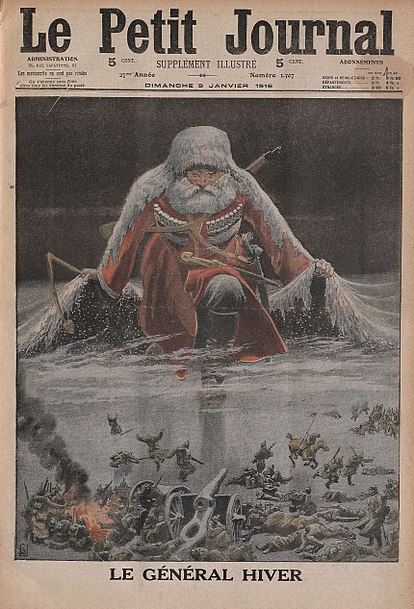
If I could propose one (and only one) fix, I'd probably go for a weather system. I feel like a good weather system creates a "rhythm" to wargame play, with good weather creating "offensive turns" for conquest, and poor weather creating "defensive turns" for reinforcement and consolidation. It also provides the breathing room to regroup and build some powerful assault units for a coordinated attack, rather than just pumping out stacks of infantry while your navy and air force is frittered away. Finally, this allows for Russia to be plucked from the jaws of defeat by "General Winter" in much the same way that it was in the real 1941 Barbarossa offensive.

Below I've written a rule based on the assumption that every turn represents about a half-year. (For the 1940 Global game, using four seasons would probably fit the scale better.) I also assume that the game's focus is on regions with a temperate (summer/winter) climate. This is adapted from the weather system from my own Fantastic Frontiers project.

Axis and Allies Weather Rule

The first turn of the game is a Summer turn for all players. Every subsequent turn alternates between Winter and Summer. In regions on the southern hemisphere of the map -- anything with a northern edge lower than the northern edge of Brazil -- the seasons are reversed.

(Optional rule to handle tropical regions: Draw an equator across the map. Every region that the equator passes through, or that is adjacent to a zone the equator passes through, is an equatorial region that has reversed seasonal variation relative to the temperate regions in its hemisphere, to reflect Wet/Dry monsoon patterns. So while the North Temperate and South Equatorial zones have good Summer/Dry weather, the South Temperate and North Equatorial zones have harsher Winter/Wet weather, and vice versa.)

At the start of every combat round, roll a 1d6 to check for the weather conditions that round. In Summer, the weather is Clear on a 1-2, and Severe on a 6. In Winter, the weather is Clear on a 1, and Severe on a 5-6. Otherwise the weather is Average, with a mix of rainy and sunny days.

Clear weather represents perfect weather for modern mechanized warfare. All aircraft and armor increase the number of attack dice they are allowed to roll by 50%, rounding fractions up. For example, a group of 3 tanks would roll 3+1.5 dice, rounding to 5 dice, instead of their usual 3. This is calculated individually for each type of armor or aircraft unit present.

Severe weather represents storms or blizzards that are miserable for everyone. All attack dice are reduced to half, rounding fractions down. A group of 4 fighters would only roll 2 dice, and a group of 1 bomber would roll no dice at all. After Severe weather, combat must end with that round. If the battle is not won at the end of that round, the attacker must retreat.