Showing posts with label rpgs. Show all posts

Tuesday, June 30, 2015

Balance And Social Contract

After the last session, I had one of my players chatting with me about how different games systems are good for different purposes. In particular, he mentioned the way that PFRPG encounters have an automated system for ensuring encounter balance through a detailed challenge rating formula.

My immediate reaction was that this was something that came at the cost of strategic decision. If an entire area consists of nothing but balanced encounters (yielding level-appropriate treasures), then there are really no encounter-selection decisions to be made. Whatever you attack, it will give you about the same challenge, scaled to your level, with roughly the same reward. There's no need to exercise selectivity in deciding whether or not to bash down a door and kill what's inside. It's just guaranteed to be something you can defeat, given average luck. Nor does it help to avoid that encounter, since the very next one will be about the same difficulty -- and yield about the same treasure. You'll just waste the time explaining how to avoid the encounter only to move on to a reskinned version of the exact same thing. So the game becomes a methodical room-clearing exercise, like many computer RPGs.

This isn't always necessarily a bad thing. In 4th edition D&D, in particular, the intent of WotC was clearly to make a good tactical miniature man-to-man combat system, and to allow that tactical combat to have a lot of richness and complexity. For someone wanting to luxuriate in a detailed tactical simulator with lots of crunchy gamist decisions to make, this is exactly the mechanics you want. Anything else would be silly -- like having everyone set up a Warhammer 40K Table, only to roleplay a parley between the Space Marines and the Tau that resulted in a truce that required everyone to pack up the table and go home.

In my current campaign, though, the ACKS rules pretty explicitly emphasize strategic-level decision. Character classes are designed around non-combat capabilities; a bard, say, is a wimpy fighter with powerful non-combat proficiency options. But more importantly, the game itself employs an old-school approach toward the integration of "balance" into the game's social contract. The philosophical contrast is this:

  • In a modern RPG, balance is a one-sided GM responsibility.
  • In a retro RPG, balance is a negotiated aspect of emergent play.
In an earlier post, I noted how old-school RPG play really has four distinct modes: (1) dungeon-crawling, (2) hex-crawling, (3) mass combat, and (4) strategic resource management. The "dungeon crawling game" bears a strong superficial resemblance to a modern packaged adventure path, with monsters populating a traditional dungeon. But the mechanics of the old-school dungeon-crawl are vastly different than in more modern systems because of the pivot away from session-long resource management. Really, most modern games have more in common with the "hex crawling game" in terms of structure, as isolated encounters that don't share resource pools.

The critical difference in the system is how hit points are understood. A modern game (4th edition onward, or any recent computer game) tends to interpret hit points as "luck", or "stamina", or "the favor of the gods". When they run out, the next hit kills you because you exhausted your supply of those intangibles. It's easy to regain those intangibles between battles with a "healing surge", or a "quick rest", or some similar mechanic. Even some spell-like effects work the same way, implemented as "per encounter" or "at will" abilities, or by allowing a quick rest to recover some or all spell slots (points, whatever). Death is replaced by a temporary knock-out effect. As a result, each combat can be balanced in roughly the same way: You assume everyone starts at full health, and build a mirror-image collection of enemies. This makes it perfectly sensible to put together a series of encounters that all have identical challenge ratings, maybe with a slightly harder boss fight at the end for drama.

A simulationist retro-RPG like ACKS extends resource management over the entire session. Hit points (understood as "flesh wounds" or "blood loss") can't easily be returned, since healing spells are pretty weak and natural healing takes forever. Spells are "per day", not "per encounter". Death is permanent, and serious injuries are realistically incapacitating. This means that putting together encounters that are "balanced" will beat down the party quickly (which might be fun for a Tomb of Horrors-esqe tournament module, but not for a long campaign). Instead, the responsibility of the GM is to ensure that most encounters are weak, and the few strong encounters are either avoidable or else are capstone events for which the party will be able to carefully plan and prepare (to wring every advantage out of combat-as-war strategems). The weak encounters never yield good rewards and drain resources, so it's more efficient to bypass them when possible. If you want a tough encounter with good rewards, you need to do the legwork to find one.

(Incidentally, I'd say that 3rd edition D&D and PFRPG are both centrist systems that encourage a little of both approaches.)

The party bears a much heavier level of responsibility for finding methods of identifying and classifying potentially difficult encounters, to know when to avoid them or how to prepare for them. Kicking down every door will eventually lead to a total party kill. Several common methods of gathering strategic information include:
  • Dungeon geometry tropes: E.g. the deep caves have nastier monsters, so dwarves get a "detect slopes and depths underground" racial perk
  • Scouting techniques: Listening at doors, for example, is usually prudent before bashing them down
  • Parley with dungeon denizens
  • Interrogation: Leave an orc alive after combat to see if you can get a sense of where the Big Bads are holed up (hopefully you took "orc" as a language!)
  • Exploiting dungeon faction rivalries
  • Disguise and infiltration
  • Divination magic (once you figure out the right questions to ask!)
  • When all else fails, exploring recklessly and then running away from that demilich...
The social contract for a GM is to provide a lot of non-fatal encounters that slowly nickel-and-dime the party's resources (spells and hit points) to the point of feeling progressively more weak and vulnerable as they approach a major objective -- so that "Do we really want to keep going?" is a tough call, not a no-brainer.

Monday, March 24, 2014

Curse You, Wyverns!

My first and second ironman playthroughs of the computer game Pool of Radiance ended in Total Party Kills from squads of typical humanoids due to my own poor preparation. The third playthrough, however, ended only after I had broken out of the city onto the world map and was happily poking around looking for that rumored lizardman city. I was in the wilderness when I get that cold chill up my spine from the random encounter text, and I realized before the combat screen had even loaded that I was already six feet in the grave. It was wyverns. Stinking wyverns.

Most older games have that one grossly unfair random encounter that seems wildly out of line with everything else around them. In this case it can't be blamed on an index overflow error or a cruel programmer. The presence of wyverns in wilderness encounters is a faithful adaptation of the PnP game tables, dating back (one supposes) to the archaic Gygax-era. Why are wyverns so uniquely horrible? Let us count the ways:

  • Start with a spider, one of those "save or die" lethal poison kinds.
  • Put it in plate armor.
  • Give it wings and speed on par with a pegasus, so nothing can successfully run from it.
  • Direct quote from the 1st edition Monster Manual: "They are rather stupid but very aggressive, and wyverns will always attack." So forget about making a reaction roll.
  • Dragon-quality 2d8 bite attack, in a system where that can one-shot any mage it lands on.
  • Swoop attack! Your marching order, it means nothing!
  • 2nd edition buff: "The final approach of the dive is done in complete silence, imposing a -2 surprise modifier on the target."
  • The 3.0 revisions nerfed their poison so they now need, maybe, two hits to insta-kill you with CON damage. And a Spot bonus so you can't hide, tasty little morsel.
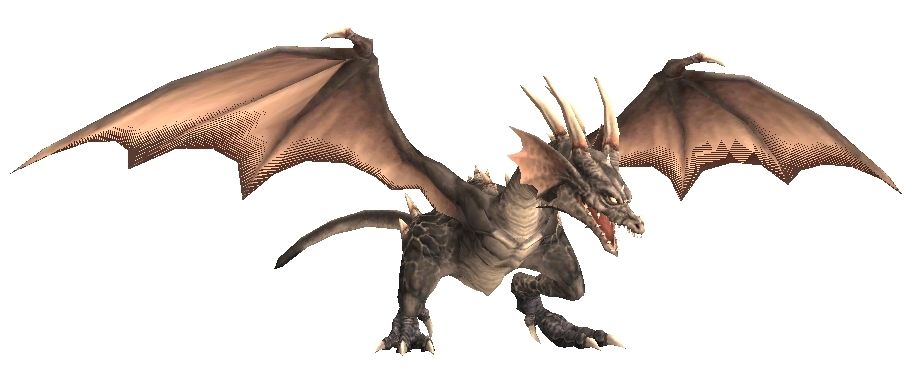
The ACKS system, which usually tones down poison a bit by giving it an onset time, specifies that wyvern poison "instantly kills" a target, a trait shared only with the purple worm.  The 2d8 is now interpreted as two attacks, allowing for multiple special combat maneuvers at once. It also specifies double-damage with talons on a dive (4d8!), with a success allowing the wyvern to carry away its target to (presumably) sting and devour, or drop for amusement. I put a couple of wings of wyverns in the first Domains at War playtest we did, and they basically savaged the opposing army single-handedly. (Bonus: ACKS also features "Giant Killer Bees", which are kind of a disposable mini-me variation of wyverns, for when the GM basically just wants to throw 1d12 save-vs-deaths against a single player all at once.)
Hard to do something single-handedly with no hands, but YNWIM
The mere existence of something like this suggests that the game you're playing is meant to be approached from the combat-as-war paradigm. It's basically exempt from all the usual evasion and diplomacy mechanics, so you have to fight it. But you can't fight something fair when it's made of this many dirty tricks. In a computer game, you basically just reload (or in ironman mode, reroll) after hitting this kind of nonsense. In a free-form tabletop environment, you need to improvise.

Wyvern-slaying ideas:
    Seriously? You want to ride me against that? I'm outta here.
  1. Nets or a web spell might be able to keep them grounded. Or tie a rope to a tree and snag with a grappling hook. Once immobile, they can be picked apart with arrows.
  2. Ride an elephant and hide in a tower on its back. At least you'll be too big to carry away.
  3. Wand of Paralyzation, the ideal bane of any flying creatures. (I've placed one in a dungeon, but so far it remains unfound.) Note that the 3.0 version of the wyvern explicitly makes them immune, so apparently Skip Williams is hip to your tricks.
  4. In ACKS, I would rule that fixing polearms against a charge will work against dive attacks too.
  5. Lots of archer mercenaries. No, not that many. Way more than that.
  6. Cast an illusion that resembles the wyvern's natural enemy, the... er... "*ahem* The wyvern has no natural enemies". You just shut up, 2nd edition MM!
  7. Write an angry blog post about them after they TPK you. That'll show the bastards, eh?


Friday, September 20, 2013

WOTC Free Classic Module Giveaway

T1-4 Temple of Elemental Evil (1e)For one week only, you can pick up a pdf copy of the original 1e version of Temple of Elemental Evil. This legendary dungeon complex taught me useful life lessons, such as "If you ever enter a place called 'The Fire Temple', and it's full of fiery symbolism and lit by flickering flames, and you're looking for someone called 'the Fire Priest', then it might be a good idea to cast Protection from Fire before triggering the inevitable ambush by fire elementals."

This is a gesture of good will in support of the release of the latest (and possibly final) 5th Edition playtest for D&D. Major changes in this version are (inevitably) all things I don't much like:
  • Proficiencies/skills now have a level-scaling bonus, shifting the game back toward the build-oriented end of the 'open stat-based vs closed build-constrained' continuum for player agency. Skills are now treated as a non-optional subsystem.
  • Multiclassing has been added back in. It's essentially the low-commitment 3e buffet model, which means (1) it's silly for casters to take any non-caster class, and (2) melee classes will go on grabbing a level or two of <whatever> for min-maxing reasons. Granted, no edition has ever had a successful multiclass system, so my expectations were never high.
  • Cleric melee abilities generally downgraded, and casting abilities upgraded. The class is back to being a healbot. You can't fight the expectations of 10 million MMO players, I guess.
  • Mages have lost their iconic abilities to scribe scrolls and brew potions, which dated back to the 70s. Apparently there was no way to balance them properly?
  • No sign of any OGL-like licensing arrangement as the clock runs down, which means that their chances of displacing Pathfinder as system-of-choice for third-party publishers will remain poor to negligible.
I still like most of the new ideas like advantage/disadvantage, and the retention of 4e's one useful innovation (ritual casting). But in virtually every case where 3e came in contact with 1e/2e, it looks like 3e has won.

Thursday, August 29, 2013

Classic 80s RPG Flavor Elements

Right now I'm trying to come up with retro-fantasy campaign optional rules for my game design project, with flavor elements that evoke some of the quirky and arbitrary rules of the 80s era (basically, 1e and 2e TSR stuff). The actual combat mechanics would wash out, since I'm not trying to implement things at the level of man-to-man combat, but I'm still trying to think about the system-independent concepts and ideas that stand out as unique to the era. Basically, anything that seemed to exist for no clear reason other than "Gygax said so", but somehow propagated through several generations of rule revisions by virtue of inertia and nostalgia.

Examples that leap to mind:
  • Melnibonean ethics by genetic destiny (orcs are born chaotic!)
  • Clerics can't use edged weapons (in any conceivable universe)
  • Humans get more specialty classes, but demihumans get to multiclass
  • Clerics get prayers automatically, mages need to find/research their spells first
  • Goofball one-trick-pony monsters based on cheap Asian toys (I <3 rust monsters!)
  • Linear warriors, quadratic wizards
  • A zillion polearms
  • Element-breathing dragons, color-coded for your convenience
  • Big, worthless treasures (You won... ten thousand coppers that you can't carry!)
  • Bumpy character progression tables
  • Vancian magic based on preparation (and baroque spell names)

Wednesday, April 17, 2013

Resource Management: Why You Need To Go Retro To Hex-Crawl

Today the retro-RPG community (organizing around Eric Tenkar's blog) has spontaneously organized a promotional campaign for the Swords and Wizardry system. For anyone not aware, S&W is a consolidation of various rules from the early days of D&D into a single unified rule book. Back in the 70s, most games were released in a piecemeal fashion through various supplements, expansions, and magazines, and so it's debatable whether there's even such thing as "classic 70s D&D rules", given the tendency of playing groups to pick and choose their own rules from a nebulous universe of such supplements and articles to create widely dissimilar experiences. But if such a thing had ever existed, it probably would have looked quite a bit like S&W does!

This put me in consideration of why the "dungeon game" (dungeon-crawling) has been so dominant in subsequent RPG products, while the "wilderness game" (hex-crawling) has virtually died. Here's my hypothesis.

Each game has an organic unit of resource management. For a classic RPG game (anything in the 70s, plus most of the "basic" line in the 80s), the organic unit was the adventure, which usually lasted for at least a day, and possibly as long as a week. Here are the resources that would slowly be whittled away over the course of the adventure in the classic era:
  • powers like the druid's shapechange;
  • spells, which (until the introduction of "portable spellbooks" in Unearthed Arcana, couldn't be rememorized anywhere except the home base;
  • consumables like food, torches, ammunition, oil, holy water, spikes, etc.;
  • hit points, which took forever to recover (maybe 1d3 points per rest-day, or something similar), and also the initial freedom from status impairments (like level drain); and
  • pets, hirelings, and henchmen, who tended to have very short life expectancies!
Now look at a modern RPG, or a computer game like World of Warcraft. Virtually all these resources have been eliminated, or allowed to replenish almost instantly. This results in a new game model where the organic unit of play isn't the adventure, but a single battle. At the end of the battle, resources like health, spells, etc, all get reset back to "full", and play continues.

A consequence of this is that there's little point in fighting anything but the toughest fights. The original purpose of random encounters (what computer RPG players call "trash") was to whittle down the party and create dramatic tension. Now they're just there to kill time and let people practice. In a computer game killing time is part of the point, but in a group session around a table, everyone's time is too precious. So the focus collapses onto a few "boss battles" and elaborate set pieces.

This basically kills the whole idea of exploring a huge, organic, realistic, sandbox-ish world. If the judge (DM, whatever) needs to prep those huge set-piece battles, then it's crucial to railroad players into those encounters and keep them from exploring anything else. This also creates a snowball effect where the game system keeps inventing cool combat-only powers/feats that further slow down the pace of those huge set-piece battles, making it necessary to invest more and more time in them and make them even more elaborate to justify the rules that support them.

Breaking out of the cycle requires everyone to give up their massive laundry-list of feat-based builds and revert to a simpler and faster style of combat. It also requires a reversion to the old "adventure-scale" resource management systems, rather than "battle-scale" resource management with full post-battle recovery. Although I see some indication that D&D Next is aware of the need to support both play styles, I'm afraid that when both exist at once, players will always gravitate toward the more-powerful feel of characters under the battle-unit model.

Hence the need for retro-clone versions of games from the classic era. It's no surprise that, of recent hex-crawl designers (like John Stater and Robert Conley), Swords and Wizardry has been the system of choice. Here's a big tip of the hat to Matt Finch for creating the omnibus rules book, and to all the folks who have supported S&W since then. The current publisher Frog God Games (which always releases dual product versions for both Pathfinder and S&W) is offering a one-day sale on their entire S&W line, and I can recommend any of Stater's Hex Crawl Chronicles as a good example of this play style. I've been consciously imitating his event description style while writing my own game events.