I can't really proceed with the fall semester campaign until I get the results of the summer transcribed for posterity. So here's a short summary of the final session, and of the full campaign. June 27, Caudex Annales, 70 AUP
The party broke into a series of smaller groups, and slowly worked their way back to Balewood Keep. Elven nightblade Terra Daystar and Dunflow the Barbarian had already arrived the previous evening with a report of the shrine battle. The less respectable duo of Meros and Wulfhere arrived together the next morning, Wulfhere sporting a new winged helmet he had looted from his extensive pillaging of the shrine's back rooms. Regrettably, the helm had born an enchantment with the effect of permanently altering his alignment to "Chaotic", and by this point he had decided that the most chaotic course of action was to isolate and murder the castellan. The jewel-snatching nightblade Meros had always been something of a bad seed, and was hardly one to stand in his way.
The two of them lured the castellan and his scribe down to the dungeons, on pretext of having some secret news to report. Wulfhere's mystic aura proved persuasive enough to set up the ambush, and upon arrival, the nefarious pair bolted the dungeon doors behind them and sprang to the attack. Terra, who had never quite trusted the other elf, followed the two of them from the shadows, and observed them through a grated window.
The initial round of combat went poorly, as Meros successfully opened with a choking grasp against the scribe, lifting him helplessly in the air before he could cast a prepared clerical spell from his scroll case. But the castellan was cast from a sterner mold, and his enchanted armor proved impervious to the initial assault. The battled turned hopeless against the conspirators when Terra slipped a magic missile past the bars of the window into Meros' back, disrupting his spell and releasing the scribe. The completion of the scribe's hold person spell ended the assassination attempt abruptly.
Fortunately the castellan did not immediately check the belongings of the traitors, or he would have discovered a freshly cut medusa-head with still potent petrification capabilities. (It was also a small blessing that neither of them thought to use it on the castellan during the fight.) When the rest of the party arrived in the upper bailey, they discovered a warrant had been issued for their arrest, and they were unceremoniously locked into the dungeon.
The following morning, the clearly insane Wulfhere attempted to overpower his guards, and was quickly slain. The rest of the party was hauled up to the great hall for an improvised trial, with the keep's bailiff functioning as prosecutor. They stood accused of having awoken the dead against the express recommendation of the castellan, of having stolen cursed insanity-inflicting relics from the tombs, of harboring assassins, of fraternizing with hobgoblins and cannibalistic lizardmen, and of generally disrupting public order.
The previously arrested (and stripped and mutiliated) visiting cleric, Father Isembart, served as a key witness for the prosecution, forced to testify by written statements due to the splitting of his tongue. His sorry condition earned him great pity from the assembled throng of civilians assembled for the trial, and the official rule of the castellan (under some pressure of rising political unrest and insurrection) was that the party should be immediately exiled into the wilderness. Privately, he communicated his hope that they could find some way to resolve the regional crisis, and he also lent them a fragment of a stone tablet artifact, a fragment recovered by another adventurer decades ago -- one who had emerged as the sole survivor of a doomed expedition.
The party attempted to return back up through the mountains into Green Pass and take refuge at Centerpost, but found the gates at Footman's Notch occupied by hostile forces flying a sinister black banner in place of Durnovar's White Ship. Meros slipped away under pretense of scouting the walls, and instead opted to simply defect to the side of the captors within. When the party was assaulted by a pack of hellhounds during the night -- easily enough dispatched, with the use of the medusa's post-mortem gaze -- it had become obvious that the occupation force was of an entirely fiendish nature. Earning passage across the mountains would only be possible through subterfuge, or by another route.
The last couple RPG sessions have seen some discussion of simply running away from the Green Pass region entirely, and leaving the area to its grim fate of eventual conquest and pillage. Here's a short summary of all the different directions that the party could go, based on a zoom-in view of the world map.
The world of Proxima, at the northern end of the occidental basin
Notes:
The party is currently at the very easternmost edge of the hex with the fortress icon, labeled "Green Pass".
The scale is roughly 200 miles per hex. Traveling along roads means that it's possible to cover this distance in a week or so. Traveling through rough terrain can more than double this time. Moving through a thousand miles of hill or forest hexes would take several months.
That's all desert to the southeast. Desert requires you bring along water as part of daily rations, consuming a stone of food and water per day. For a party of ten, that works out to 3000 stone of water per month, which would require a fleet of camels to carry. Although there are alternatives to bringing water along...
There are other passes through the Great Barrier Mountain Range, in addition to Green Pass, but none of them are civilized.
Most of the realms on this side of the mountains are chaos-states run by high-level necromancers, witches, or evil warlords who rule populations of orcs and such, and who use humans only as slaves.
Directions the party could try to go:
Directly back through Footman's Notch, into the Green Pass region: This follows a presumably safe road. However, it's under the control of a Durnovaric garrison that might not be entirely willing to allow the passage of normal traffic from the east, especially for a party under a cloud of suspicion as being the kind of grave-robbers who probably triggered the crisis in the first place. There's already been serious political pressure to close the gate, to prevent the migration of suspected cultist infiltrators.
North along the edge of the mountains: This leads to a vast wilderness of cold high-elevation pine forests, and eventually to the northern sea. At this time of year the weather is mild enough to be above freezing, but still chilly overnight. In the winter, this area is choked by snows. There are plenty of fierce beasts and magical creatures here, but the only sentient inhabitants are small and isolated settlements of hostile kobolds and other such mountain-dwelling beastmen.
South along the edge of the mountains: This is the rumored direction in which lies a great passage through the underdark beneath the mountains. Pirates far away on the Larcenous Shores send their prisoners to the east in desert caravans, using the tunnel to deliver their captives to the chaotic lands in the east to live unhappily as slaves for the various immortal Undying Lords who live in the Hyperborean Basin, hundreds of mile to the south of Green Pass. The exact tunnel location is unknown to Durnovar, but probably well known to the slavers in the area.
East into the Hyperborean Desert: This is the location of the vast ruined cities of Thule and Nerigos, the true imperial centers of power, citadels of which the nearby city of Umeskelion was merely a satellite. Both cities are nearly a thousand miles away, accessible only through the trackless wasteland of shifting sands that have slowly buried them.
I'm moderately disappointed that no one in the party decided to charge a valley full of 100+ gnolls, orcs, and hobgoblins. That would have been the evening, right there. Maybe next time. June 25-26, Caudex Annales, 70 AUP
Getting out of the keep ended up being trickier than anticipated. A furious mob of local merchants and their mercenaries had gathered in the lower bailey to demand the right of egress, and to insist that if they were denied it, then no one else should be granted permission to leave either. The bailiff was attempting to maintain order with small force of guards. Worse yet, the locals were not apt to be especially well-disposed to the news that the "adventuring team" who had been robbing graves and (most likely) awakening the dead were attempting to leave after having dragged away the well-liked visiting priest, Father Isembart, to the dungeons for who knows what kind of mistreatment.
After a good deal of debate over the virtues of simply lowering a rope over the walls and slipping away, the party elected to buy a large keg at the tavern and invite the mercenaries back for a free round of drinks on the house. The bailiff seemed a little relieved at the resolution of the situation, but also warned that leaving the keep during a crisis would be regarded as evidence of guilt without counter-evidence that the real conspirators had been located and eliminated. The party elected to march to the secret back-entrance into the catacombs seen by Malcom's ESP investigations. Meanwhile, Zigzinu took a horse down to the swamps to parley with the lizardmen, and slowly brought them around to the conclusion that helping the party against the cult would be a better source of tasty mammal flesh than raiding the dwindling traffic of zombie-averse caravans.
The trees, they're full of elves!
The rest of the party (along with the chapel's curate Father Hubert, replacing the injured Brother Bartimaeus) advanced to the valley entrance, where they discovered a small battle already on the verge of erupting. The local factions had drawn up into two camps, with the gnolls and orcs allied against the hobgoblins and a few goblins. Terra Daystar went on overwatch by stealthing up a tree on the ravine slope, and Dunflow and Wulfhere constructed a few simple traps. At this point the elf decided that her elevated position was ideal for launching a few sling bullets. Given the range it wasn't too surprising that they both missed, but they did attract a bit of attention from the orcs, who deployed a squad to investigate the trees in search of "hobgoblin snipers". The hobgoblins knew perfectly well that something suspicious was afoot, and sent some reluctant goblins to keep an eye on the orcs.
At this point the orcs blundered into the traps, and all hell broke loose. The hobgoblins made some effort to warn the orcs, but the orcish response only further infuriated them, and by the time the gnolls closed into melee the battle was inevitable. With the orcs support infantry partially disabled by traps, the gnolls were easily taken apart by the well-organized hobgoblins. Unfortunately, the paranoid hobgoblins had little interest in rewarding their unseen benefactors, and Terra remained helplessly treed like a squirrel by hounds.
At this point, Finkle ensorcelled Wulhere's steed into an illusory dragon, with Reed casting some fire out of its snout for good effect (and incinerating some goblins in the process). This got the attention of the hobgoblins long enough for a parley, with Wulhere presenting himself as the champion of a "hobgoblin spirit" living up the tree. Elves speak the hobgoblin tongue with sufficient fluency that Wulfhere and Terra were able to conduct a sort of strange three-way conversation, with the talking tree issuing orders to the hobgoblin chieftain to attack the cult of the horned god in the shrine. When the chieftain seemed unpersuaded by this somewhat implausible tree-given request, Wulfhere went double-or-nothing and challenged the chief to a single combat. Fortunately hobgoblins are always itching for a fight, and the chief took the bait despite his wounds. The brawl nearly cost Wulfhere his life and left the party facing three-dozen angry hobgoblins... but at the last minute the chieftain went down, and left the in control of the remaining forces of 12 spear guards, 2 crossbows, 9 hobgoblin wenches, and 3 of the chieftain's harem's most beautiful consorts (well, beautiful by hobgoblin standards, at least).
The lizards, slow as ever, arrived late in the evening, and gorged themselves on the corpses of the dead, leaving a gruesome arrangement of half-gnawed bones and viscera all over the valley. The chambers of the defeated orcs and gnolls were plundered for treasures, and the party set a hobgoblin watch over the entrance to the cult's tunnels.
The next morning, Finkle decided to down a potion of gaseous form and go exploring in the tunnels. (Note: This leaves behind all equipment and clothing, but the cursed gem's enchantment forced it to constantly follow him down the hall, dropping to the floor with an echoing clunk and then teleporting to his new position to repeat the cycle.) This being a poor substitute for invisibility, the acolytes of the shrine spotted the billowing cloudy outlines of a buck-naked gnome within the first hundred yards of the shrine's entry hall, as he tried to slip into their private chambers through a keyhole. The resulting chase had a temporary lull when he found a blocked-off tunnel full of boulders and slipped between them, discovering a long passage leading up to the barrow catacombs. Unfortunately, by this time the entire shrine was alerted and a company of four acolytes, four adepts, and an evil priest had arrayed themselves on the far side of the boulders to intercept his escape. Finkle released an phantasmal courier to race past them to the exit, announcing his discoveries to the guards outside, and then created a brief covering illusion to slip past them.
Unfortunately, the entrance had already been corked shut by the arrival of a nearly-transparent gelatinous cube, closing off any crevice of escape. Finkle raced back into a maze of tunnels in the other direction, finding a small prison cell with a rather attractive female prisoner inside (even by non-hobgoblin standards). Alas, when she turned to look it him it was obvious that she was having a bad hair day everything, being coiffed with a collection of writhing snakes, and Finkle turned from gas to stone without stopping at flesh in between. Kinda figures that the hot chick in the cult dungeon turned out to be a bakku-shan.
The cursed gem finally managed to materialize in Finkle's stone hand, triumphantly crowning his new career as an X-rated lawn ornament.
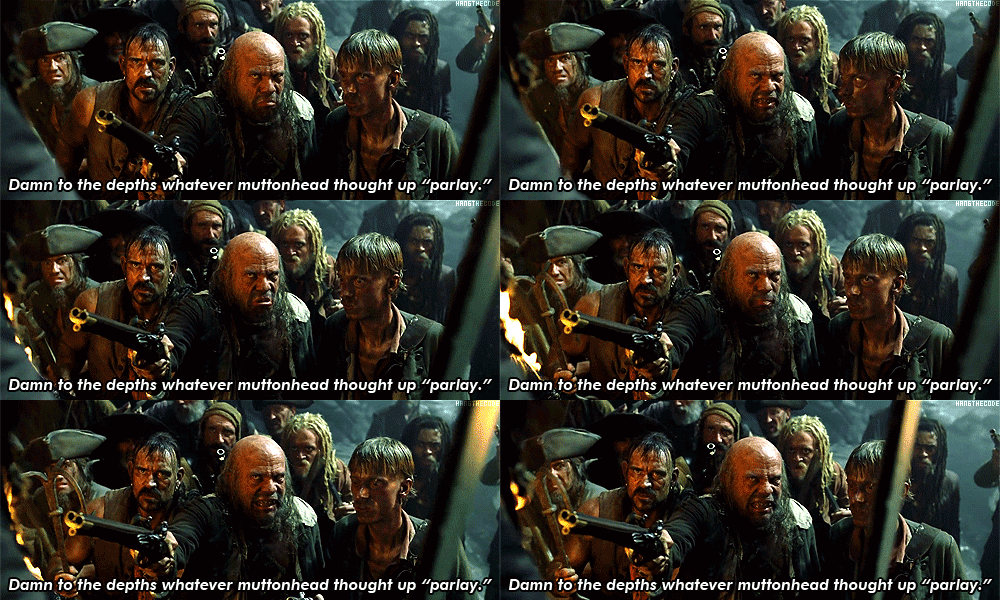
To close, here's an illuminating dramatization of the elite gnomish espionage protocols on display:
Casualties
Finkle Bagnozzle: Turned to stone by a gorgon medusa (because in D&D gorgons are actually giant metal cows with bad breath, for some odd reason)
(Note: Lizardmen don't count as "defeated" for xp purposes, since they weren't initially hostile, but hobgoblins do.)
Total experience from treasure: 1458 xp
Total experience from kills/captures/deceptions: 1855 xp
Total experience from exploration: 0 xp
Total experience: 3313 xp Total experience per member: 301 xp
(Note: Mort the Wardog is taking an experience half-share but not a treasure share. Father Hubert, the curate, is taking both.)
This session consisted of everyone standing around trying to figure out what to do next. Eventually Sherlock noticed that ESP is totally broken, and used it to render the whole encounter trivial. This impudence will not go unpunished!
No treasure or experience, since there wasn't much in the way of treasure or exploration. I'll roll it over into the results of the next session.
June 25, Caudex Annales, 70 AUP
Everyone enjoyed a good night's rest, as the arrival of a crew of new adventurers from Centerpost at the end put the tavern in good spirits. Naturally this would not last, as the next morning's weather featured unusual atmospheric disturbances of a necromantic sort. Everyone piled out to gawk at the portent of doom, while the keep's upper echelon of officials moved into the upper bailey to hold an emergency town hall meeting. Helga the wonderworker went into another prophetic trance and had a vision of the shadow spreading out from the Hyperborean Desert's ruined cities of Nerigos and Thule hundreds of miles to the east, and eventually dominating the continent -- but not before a great deal of infighting between various chaotic factions.
After a good deal of deliberation about the best direction to run away, the elf Terra Daystar finally suggested that it might be polite to at least give the castellan some notice before abandoning ship. The party had little difficulty convincing the guards they could be useful as participants in the meeting and arrived in media res, as everyone was discussing the source and nature of the present crisis. The chapel curate had already brought up the mosaic showing the Black Legion parading as it once was in life, and the idea of facing an elite fighting corps of the ancient world sworn to the service of a dark god of chaos wasn't welcome news.
A good deal of speculation arose about the next course of action that might be taken by Lord Varghoulis. After a great deal of discussion, the following conclusions were tentatively drawn:
The newly raised forces loyal to Nergal would face local opposition from other factions already raising undead in the catacombs, and would probably need to consolidate power before marching to assault Balewood Keep.
As knight-captain of the Black Legion, the death knight Varghoulis would probably have limited necromantic skills himself, and need to make an alliance with some more powerful necromancer in the area to augment his forces and seize control of the free-willed undead in the area.
He'd probably want to raise some kind of undead mount, swift enough to travel the long path to the ruined temples of his masters in the east. The castellan's elvish advisor speculated he might try to seek the grave of a long-dead black dragon, to animate the skeleton.
The visiting priest recommended seeking out one of the rival chaotic cults in the catacombs, to see if they could join in an alliance of convenience against the forces of Nergal. This suggestion horrified enough of the party to cast suspicion on the priest's motives. The castellan suggested the possibility of a infiltrator already at the meeting, with the result that the mage Malcolm Hawk elected to interrogate the entire room simultaneously with an ESP spell. The visiting priest was immediately revealed as a servant of the cult of the Horned One, but without solid proof, this was only good for a severe case of Cassandra syndrome.
Everyone adjourned while Finkle scouted the high moors from the air, mounted on Helga's baby roc. (He would eventually return to report that the Legion had gone underground already, apparently through the main barrow entrance.) Petitioned by Malcolm in private audience, the castellan seemed deeply suspicious of the accusation against such a well-liked member of the community, but still approved of pursuing it to the point of investigation. Once the meeting went into recess, a single well-placed sleep spell -- by a mysterious newly-arrived paladin named Wulfhere who shouldn't have been able to cast arcane spells in the first place! -- immobilized the priest and his two acolytes and they were unceremoniously hauled off to the dungeon.
At this point, everyone in the party went a little psycho-crazy. The acolytes were murdered in cold blood, and their bodies burned and crushed into powder ("so they can't be raised as undead"). The priest himself was stripped down, and bound with chains on every limb. The sweet and innocent elfchild Terra made of point of permanently mutilating his tongue with a knife, then shaving his head and checking "his inner thighs" for evil runic tattoos. (It's always the shy ones who are into that stuff, eh?) So much for a fair trial with witnesses and evidence and all that.
Meanwhile, the saurian Zigzinu was dispatched back into the swamp to parley with the local lizardmen tribe. Because there just hasn't been enough talking already today, apparently.
At the end of the session, the party had just about settled on forming an expedition to the catacombs, looking for additional volunteers to accompany them from among the local adventurers...
Coming soon: A roster of everyone of local interest, for sake of reference.
One peculiarity of Tolkien's reinvention of Northern European mythologies is that it appeared in several distinct forms: the "children's fiction" of The Hobbit (along with some similar early poetry), the high fantasy Lord of the Rings trilogy, and the elaborate mythology laid out in the Silmarillion and other unpublished works. The result is that the reinvention of fantasy staples like "elves" and "dwarves" created not just a single depiction, but a number of competing presentations. Elves in The Hobbit are frivolous and wild merrymakers, while elves in the trilogy are noble warrior-sages.
Mucha, The Four Seasons
While the setting of Middle Earth creates an explanation for why elves come in different varieties, I think the basic idea of elves being divided by history and genetics is less interesting than the idea of them being divided by temperament. In a game setting, no one has enough time to listen to a long discourse on the history of your pseudo-Tolkienesque elves. But the personality types are immediately obvious. I've grouped them by "season", which seems appropriate for a nature-oriented magical race.
Vernal Elves
Vernal (springtime) elves are lighthearted and full of nonsense. They love jokes and jests, and are prone to singing and dancing. They are sanguine and make for pleasant company, at least for those with a tolerance for their foolishness. They are hard to motivate, and tend toward the vice of frivolity. (Example: Rivendell elves in The Hobbit) Estival Elves
Estival (summer) elves are seekers of pleasure and leisure. They love wine, feasts, and hunting, and favor epic poetry and romantic ballads. They are skilled at entertaining, although they often dislike the intrusion of uninvited outsiders. They are boastful and stubborn, and tend toward the vices of arrogance and passion. (Example: Elves of Mirkwood in The Hobbit) Autumnal Elves
Autumnal (autumn) elves are melancholy, weighed down by sorrow and longing. They secret themselves away in distant forest groves, either dreading change or else seeking a quiet reconciliation with the loss it brings. They are wise and noble, and have a fondness for ancient lore. But they are tragic, living in a world of fading dreams, and prone to the vice of despair. (Example: Galadriel and the elves of Lothlorien in the trilogy) Hibernal Elves
Hibernal (winter) elves are brooding and intense, and are susceptible to anger or jealousy. They value craftsmanship and warfare, and are quick to take offense and slow to forgive. They make for powerful allies, but fearsome enemies. They are prone to the vices of cruelty and vengeance. (Example: The Noldor, particularly Feanor and his sons, in The Silmarillion)
Again, these aren't subraces or species of elves, but elves of a given personality type and philosophical outlook. In a fantasy game world where elves are often found in the same geographical regions as fey creatures, it would make sense that these tendencies would emerge not genetically but from contact with that aspect of the faerie realm. Vernal elves would be influenced by the company of playful sprites and pixies, estival elves would make their homes amid lusty satyrs and centaurs, autumnal elves would prefer to live near dryads and nymphs, and hibernal elves would be hardened by living a constant state of war with sinister fey like boggarts and formorians.
In my own game world setting of Proxima, I imagine that these classifications are explicit -- so that someone could actively refer to a group of elves as "Elves of the Summer Court", and everyone would know exactly what that meant.
It's becoming important to nail down the precise relationships between different groups in the Green Pass region, now that the agents of the long-forgotten evil god Nergal are running amok and threatening to cause trouble. Ordinarily the logical response would be to create a Combined Army of Good to combat the threat, but of course that's easier said than done. Here's a rough breakdown of where different religious views are in conflict, complicating that kind of cooperation.
The Church of Durnovar
Description: Basically medieval Catholicism with the serial numbers filed off. Formally monotheistic, though with the usual assortment of celebrated angels and saints who have their own private cults (which the Archbishop of Durnovar grudgingly tolerates).
Common Classes: Cleric, Wonderworker, Paladin, and a few fighting Mystics
Enemies: Pretty much any religions that follow other gods, but especially cults. More liberal members might argue that the more benevolent gods of the old pantheons are "angels freelancing under different names" -- but you wouldn't want to say that in front of the Archbishop.
Old Faiths
Description: Basically pre-Christian medieval paganism. Instead of filing off the serial numbers, I'm inclined to just leave the names the same, but change up their domains a little. It's easier to say "This dwarf is a cleric of Thor, but Thor is also a god of smiths in this world", rather than say "This dwarf is a cleric of Norvek, who is a god kinda like Thor -- and now I expect you to memorize two dozen gods I made up the same way, and also to know which real-world mythological figures they most resemble."
Ancient Civilizations (Mesopotamian/Egyptian): Marduk, Horus, Isis
Common Classes: Priestess, Shaman, non-chthonic Witch, Bladedancer, and any divine Dwarven or Elven classes
Enemies: The Church of Durnovar (which wants to absorb/replace them), other pantheons, and underworld gods within the same pantheon
Cults
Description: All pantheons have a malevolent underworld god who is tolerated but rarely loved. Sometimes a cult will spring up of unscrupulous types who try to curry favor with the underworld by expanding its ranks through wars or human sacrifice. These groups are secretive and try to conceal their structure and leadership. The Church of Durnovar regards all these "gods" as merely diabolical fiends from the Abyss, although that's mostly a matter of semantics.
Alignment: Chaotic
Popular Gods:Tiamat, Orcus, Sutekh, Nergal, Demogorgon (all in their classic D&D incarnations, not their more nuanced real-world ones)
Common Classes: Anti-Paladin, chthonic Witch, plus evil versions of any standard divine class (usually casting reversed versions of healing/buffing spells)
Enemies: Pretty much everyone, but especially rival cults (hey, that's chaos for you!)
Tether went home for the summer, so we're down by one player. At this rate, I'm not sure if there will be anything left when he comes back. I spent a while frantically prepping the catacombs before the session, so predictably that was the one place that nobody wanted to go.
June 24, Caudex Annales, 70 AUP
While Malcolm recovered from his excessively intimate encounter with a spiked pit, the rest of the party went back to Centerpost for the week. Piper the bard decided to propose to the long-suffering sage Fridaswitha with a 300 gp ring, which in hindsight should have tipped everyone off to start checking his socks for suicide notes. Frida implored him to retire to a life of musical performance, but instead he slipped off on some scheme to create a complete tailored set of vestments to robe himself as a Necrolyte of Nergal. He decided to keep this new costume secret from the rest of the party as a surprise. Everyone loves surprises.
On the way back, he elected to have a peek at the runic tablet that the sage had pushed away in horror. One glimpse of the cursed runes and Piper promptly took permanent leave of his sanity. No one noticed immediately, given his reputation for erratic behavior. This gave him plenty of time to slip off toward the haunted moorlands by himself, once they had settle back in at the keep's tavern. More on that later!
That face is so wrong
Meanwhile, everyone else (except Meros, who wanted to loot more graves) voted to head to the orc-infested cave area for more clues about the threat from the east that had initially most worried the castellan. They set out along the road, and carefully scouted the entrances to the caves upon arrival. Most of the entrances were dead quiet, but one of them stank horribly and another was emitting a mysterious din of beastly noises. Scouts reported a number of small flying monstrosities within in a generally agitated state (agitated mainly because Finkle dumped a drive-by faerie fire on one). The prospect of something worth smashing excited the martially inclined saurian Zegzinu, who began lumbering toward the cave at top speed (20' per round) in hopes of a fight -- with everyone else following a few steps behind. Upon his unsubtle entrance into the first high cavern in the tunnel network, a group of angry ACKS-style stirges immediately descended to feast upon the party's blood.
The tumult of battle attracted the attention of the cave's real master, a grumpy minotaur, as well as a few hungry beetles. They all moved quickly to the entrance in time to to intercept the second wave of the party's reinforcements and create a thoroughly chaotic melee. The minotaur brained Bartimaeus with an axe, despite heavy damage from Reed's earth's teeth. The stirges managed to extract enough blood from Bar Helm to render him comatose, perforating his limbs, abdomen, and face with their greedy proboscusesprobiscesprobosci pointy-type-noses. Meanwhile, Dunflow's evisceration of the beetles back at the entrance tunnel suggested that Renata was probably rather more unhappy about losing her broadsword (+3, in fact) than was previously appreciated.
The minotaur's lair was at the end of a mazelike set of passages that would have allowed him to easily pick off scouts one by one, so it was probably lucky that the fight lured him into the open. Behind a stone slab in the lair, the party discovered a collection of treasures, including two locked chests which Zegzinu promptly smashed into smithereens with a spear, the classic lizard lockpick. (Breakin' stuff!) This violent approach tragically resulted in the loss of a growth potion.
Meanwhile, the chorus of voices now swirling inside Piper's head were full of all kinds of helpful advice. Most of the advice revolved around applying his prodigious diplomatic skills toward the considerable challenge of befriending the lonely long-dead champion of Nergal sleeping in the southeastern-most barrow mound. A bit of small talk via more blood-seeping messages in the dust revealed that the Black Legion captain's favorite food was "the marrow of a righteous man's bones", and Sir Pants-on-Head the Bard felt comfortable interpreting this as a generous dinner invitation, to the resounding approval of his newfound cranial interlocutors.
He set himself to work with good cheer, smashing apart the great band-wrought doorway with a pickaxe, and donned the bespoke ceremonial vestments that he had purchased in Centerpost at great personal expense. Oh, but he looked absolutely fabulous in the matching pair of demon-face gloves, crooned the voices. Descending the stairs into the crypt, he discovered a sarcophagus with a bas relief stone-carved knight on the cover, and pushed it aside to reveal a wight -- who was not, in fact, Varghoulis at all, but only his faithful gonfaloniere.
The gonfaloniere was greeted by a rollicking birthday-celebration polka.
Varghoulis himself was in a matching chamber beyond a secret door in an even finer sarcophagus. Opening this sarcophagus (which the wight accomplished with contemptuous ease) had the effect not merely of releasing Lord Varghoulis (Captain of the Black Legion, Champion of Nergal, Inquisitor-General of Umeskelion, and general Scourge of the Living), but also of similarly arousing the entire guards-corps of the legion, including four nearby lieutenants and ten sergeants from an adjacent barrow with their accompanying contingent of adjutants and attachés -- all in an advanced state of decay and undeath. As they broke forth from the earth like frogs boiling out of swamp mud, the sky darkened and erupted into a swirling and crackling vortex of necrotic energy that stretched up into the heavens, a hellstorm that announced apocalyptic doom to everyone for miles in every direction
It was a good bit of solo work, and with his last vestige of sanity the charming and charismatic bard rolled a successful reaction check that established himself as an honorary officer of the Black Legion's fife and drum corps. Which just goes to show that combat skills are vastly overrated, whereas diplomatic specialization comes out ahead every time.
Lord Varghoulis: "Sup, bro."
Casualties
Brother Bartimaeus, addled due to brain trauma (-10% experience, -2 proficiency checks)
Bar Helm, blinded in one eye (-2 ranged attacks, requisite eyepatch)
Treasure and Experience
Coins: 903 gold and 310 electrum (=> 1058 gp)
Gems/Jewelry: 3 pieces of jewelry (1600, 900, 600) (=> 3100 gp)
Trade Goods: a pair of minotaur horns (320 gp)
Items of special interest: 2 potions (gasous form, ?), the minotaur's spear, a suit of ornate plate mail, and a staff
Total nonmagical treasure value: 4478 gp, less 64 gp (20% fee) to appraise jewelry Gold per share: 465 gp
Explored: minotaur cave complex
Kills: 1 minotaur (320 xp), 9 stirges (117 xp), 3 fire beetles (45 xp)
Put to flight: 2 stirges (25 xp)
Total experience from treasure: 4478 xp
Total experience from kills: 507 xp
Total experience from exploration: 100 xp Total Experience Gospel Choir: ft. Barry Manilow
Total experience: 5085 Total experience per member: 509 xp
(Note: Mort the Wardog is taking an experience half-share but not a treasure share. Brother Bartimaeus takes a half-share of each.)
I can't see how Peter's bard is going to survive this, but we can at least rest assured that he'll be remembered fondly as another exemplar of his celebrated profession.