Showing posts with label review. Show all posts

Friday, August 8, 2014

Fix This Game! : Conquest Of Nerath

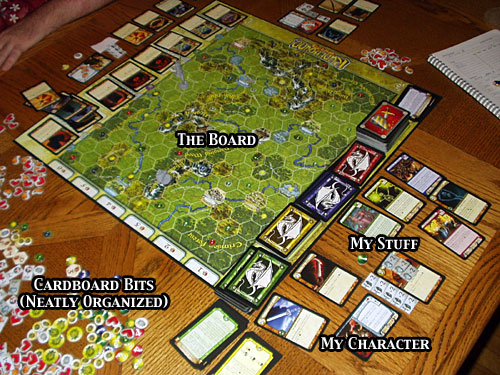
This summer we've picked up a few new board games for the collection: an expansion for Firefly, a pocket copy of Ogre (for only $3!), and WotC's Conquest of Nerath (CoN). The latter is something I've been eyeing for a while, as it resembles a deliberate retro throwback to the 80s-era Milton Bradley games, but the price was out of my range. When it hit 40% off, I tossed it into a bulk order from Amazon to have a look.

The game was released in 2011 as part of a string of board game releases with tie-ins to the 4th edition RPG rules, and this board provided the fullest look at the default campaign setting map for 4e. (Perhaps permanently, now that the 4e setting is being unceremoniously orphaned.) It's a standard Risk/A&A map with around 100 map regions, partitioned between four starting kingdoms. Each of them is roughly but not exactly balanced, creating a different strategic situation than the historical setup in Axis and Allies. In particular, there are no "punching bag" players like the USSR, and every nation has equal ability to implement both land and naval strategies.


Before I say anything critical of the design itself, I should point out that the components are all high-quality, with many unique sculpts for each player realms' minis. The box comes with a well-designed plastic divider that makes set-up easy, and everything feels sturdy and durable (aside from some thin cardstock for the card decks). It looks suitably impressive to see all the little armies spread out across the map. And (apropos of something using a D&D license) the game features a set of multicolored polyhedral dice that can be satisfying thrown around in huge handfuls to resolve battles between massive army stacks. Finally, the basic idea of a game that balances dungeon delving and exploration is a nice twist on the classic Risk model of pushing armies around a board, creating a two-linked-games approach reminiscent of the (admittedly better playtested) War of the Rings game. It also keeps the game from dragging out longer than 5 or 6 rounds, since by that point at least one side has done enough dungeon-delving to win.

Unfortunately, the designer of the game (Richard Baker, best known for the TSR-era Birthright setting, and a primary designer for the A&A miniature games) was unexpectedly fired for unknown reasons shortly after CoN was released. This means that the game has mostly been abandoned, with little support from the publisher and virtually no prospect of an expansion or follow-up game. It would have been lovely to see a similar strategy game for a familiar setting like Greyhawk or Faerun. One of Baker's interviews mentioned some prospect of a Dragonlance version, but all that seems to have fallen by the wayside.

It also means that there's little chance of an official resolution to some of the observed balance problems in the game. The rules allow for both a free-for-all and an alliance version. The free-for-all version is somewhat self-balancing, in that everyone tends to gang up on the strongest player. Hidden event and item cards can make it a little difficult to identify exactly who is ahead, but you can't be on the verge of wiping another realm off the map without gaining a lot of attention! The alliance version, though, has produced a lot of objecctions, with some reviewers claiming it favors the evil side (which always gets to move first). Curiously enough, three solo playtests of the game produced exactly the opposite result for me, with the good side pulling ahead and winning cleanly.

What's happening is this: The game allows for both short and long victory conditions. The evil side gets a position advantage from the first move, which leads to a jump in initial victory points that puts them ahead. Then the good side gets a bunch of catch up mechanisms (better event cards, and more access to dungeon loot) to help them fight back into the game. This makes the game almost impossible to balance for all length options. Play a short game, and Evil has a natural edge. Play a long game, and Good can usually make up the difference plus a bit more; a long game usually is won on dungeon loot, given equally skilled players, and Good has better access to more dungeons unless they completely collapse. (Reviewers who failed to discover this probably didn't keep playing until the later turns, I think.) There's a "medium" game that is probably the only alliance-victory version that plays with reasonable balance, but the other two victory conditions each create an imbalance in one direction or another.

As a secondary problem, the game also features several units that feel underpowered relative to the others, and don't have clearly defined roles. It's pretty straightforward to do a statistical analysis of dice outcomes that proves that "fighters" (a basic hero unit) are uniformly superior at equal cost to either siege engines or monsters (the other two primary offensive land units). As a result, virtually no siege engines or monsters will be built by an experienced player, and armies become less diverse as play progresses. This problem only gets worse as the game progresses, as dungeon delving coughs up multiple cards that grand more abilities to heroes.

Richard Baker, on his personal blog, has already recommended reducing the power of dragons -- which are basically flying A&A battleships, for only 5 times the cost of basic infantry! -- by preventing them from ending the turn in the same region. This makes them powerful on the offense as they converge on a target, but forces them to spread out and become vulnerable again on the defense. It's a decent hack for its own sake, but it still doesn't address the main problem of siege engines and monsters feeling underpowered relative to heroes.

I've been contemplating some rules changes to help both of these units and make them viable choices again. On the BGG forums, I've seen some basic recommendations like "give siege engines an extra attack die", but they feel too pedestrian and not strongly flavored from a simulationist standpoint. I feel like in addition to balance, it's also beneficial to give the units specific roles. Here are my short recommendations for making these units useful again. As a side-note, these changes strengthen the advantage in initial armies provided to the evil side, which helps with long-game balance issues (while making short-game balance problems even worse -- but more on that in a bit!)

Conquest of Nerath House Rules
1. Richard Baker's semi-official dragon nerf: All dragons must end the turn in a unique region. If a dragon shares a region with any other dragon(s) at the end of a turn, all additional dragons must be removed until only one remains.

2. Hard counter limit: No additional figures or chips may be used beyond those in the box. Red chips placed under figures count as 3 grey chips, not as 5. (Note that in conjunction with the dragon nerf, this means no realm can ever have more than four dragons on map at once.) If a card provides free units that can't be built, it may be held until those units are available again, even if it says "play immediately".

3. Siege Engine siege-combat attack buff: Any time a siege engine is attacking or defending in the same region as a castle (friendly or enemy), it gains one extra attack die. This means that siege engines would then get 2 dice on the defense, and 3 on the attack.  (Note: This enhances the ability of the Evil side to capture at least one castle by the second turn, which I think is the only way they can get far enough ahead to win a long game.)

4. Infantry / cavalry / artillery synergy rule: For each matched triplet of footsoldier, monster, and siege engine units included in the "Roll Other Damage" step of any land battle (after removing any First Strike losses), you get a "re-roll" -- the opportunity to roll again any one die that initially didn't hit. So if you have 5 footsoldiers, 4 siege engines, and 3 monsters in a battle round, you can re-roll up to 3 of that round's (non-First Strike) attack dice that would otherwise have missed. You only get one chance to re-roll each die, even if you have more re-rolls than misses. (This works like the similar mechanic in War of the Ring.)

5. Warship / elemental synergy rule: As above, but for matched pairs of warships and elementals in a naval battle.

************************************************************************

The counter limit makes it a bit harder to turtle with ridiculous stacks of two dozen footsoldiers, like the Soviets usually do in Axis and Allies. The siege engine rule makes it easier to attack castles, which also shifts the military side of the game toward an offensive bias.

I especially like the last rule, since it reflects the idea that each set of dice rolls is representing some complicated set of tactics on the micro level: siege engines softening up defensive embankments, monsters crashing through the lines to pocket them, and footmen finishing off the encircled pockets. Units work better in cooperation than they do alone, so you want to bring a well-balanced force. I thought about creating a similar fighter/wizard rule, but they seem strong enough as it is!

What about the final situation, when using the short victory conditions that favor the evil realms? I thought of two possible rules. First, you could reverse the order of the 3rd and 4th player. That means that Evil would go 1st and 4th, and Good would go 2nd and 3rd in each turn. As a side benefit, that would allow players on the same time to do their turns simultaneously, reducing downtime.

Alternatively, you could introduce a defender retreat rule, which allows defenders to limit combat to a single round, and then retreat to any friendly adjacent region at the end of the round. Only the attacker would get to roll, and any defender units that are destroyed during retreat would instead by "shattered" and be available to immediately come on as reinforcements for 1 gp each (just like the "Rod of Resurrection" item in the game). This would mitigate the effect of trying to defend against a superior opponent, as happens frequently to Good in the first couple turns.

Sunday, April 20, 2014

Firefly Board Game: First Impressions

Due to the holiday (and my general feeling of being overwhelmed by work and children) there was no official MEK OP event this weekend, although some members were talking about meeting at our FLGS, Three Suns Unlimited. Instead, I stayed home and played some two-person Firefly with my wife.

Firefly is a pseudo-RPG with a strong thematic tie-in to the short-lived TV show of the same name. You control the crew of a tramp freighter which cruises around a small map with a localized star cluster, looking for shipping jobs and performing acts of petty crime on the side. You can upgrade your ships, hire crew, and equip them with new gear. There's no "leveling mechanic", but otherwise it's all standard RPG fare with the standard dice-rolling skill tests, here using a d6. Run quests, get money, buy more loot.

The game has the standard strengths and weaknesses of other games of its type. It does a superb job of matching the feel of the original show, which is an impressive feat given that the show lasted for barely half a season. Virtually every bit of dialogue has been mined for some kind of event card or character profile. Any extra who appeared for 7 seconds is probably in this game on a mercenary card somewhere.

There are a few nice mechanics here. Every time you complete a quest ("job"), you have to make an extra pay-out to your crew. This motivates you to run jobs with the smallest crew possible, and forces you to keep looking for harder jobs to pay your growing crew. The game creates a strong sense of self-pacing, even aside from the incentive of competing with another player.

The most original mechanic is a couple of hostile ships representing the Alliance (law-and-order, trying to catch smugglers and criminals) and the Reavers (psycho space marauders who just want to kill everyone). The two ships move based on decks of cards that you're forced to draw as you move your own ships. Eventually each deck has a card that will teleport one or another of the ships directly onto you, causing lots of nasty effects. This creates an unpredictable timer that tends to go off right as you're about to execute some brilliantly devised scheme, rendering it all for naught.

Whether you like or dislike this kind of random mechanic, it certainly is a faithful representation of the thematic source material. By the end of the game, you'll really feel like a harried freighter captain, abused from all sides by demanding underworld figures and constantly on the run from the law.

There are a number of mechanics missing from the game that I would rather enjoy seeing included. The map is always fixed, and playing every game on the same fixed map starts to feel repetitive. (This is one of the reasons I'd like to design a random-map game of my own, if I ever find the time!) There are underutilized game concepts that feel like they might be vestigial bits of some earlier design of the game: ships have a printed "purchase cost", despite being all identical and coming for free at the start of the game, and the "stash" cargo storage area on your ship is literally referenced by only a single card in the entire game.

The level of randomness in the game is high. Sometimes the dice will reward someone for using an ill-conceived strategy, but punish someone else for playing cautiously. Screaming at bad die roll results or ill-timed event cards is an expected outcome of play.

The production standards for the game are uniformly high. Everything is beautiful, down to the money, and the game sells at a fairly impressive price point below $50. If you have any interest in the old show, it's highly recommended as a nostalgia trip.

Friday, April 5, 2013

Game Review: Runebound

As an example of a game review, here's a write-up for Runebound, one of several wilderness exploration games I've collected as an example of the hexcrawl concept applied to a board game. Runebound had a troubled release cycle that left me with a bad taste in my mouth; the first edition of the game was replaced (within about a year) by an improved second edition, and then all expansion products were associated with the newer edition. This had the effect of sticking early purchasers (like me!) with an obsolete game. Still, the new edition has proven quite popular, with a half-dozen expansions released over the last decade.

Runebound

Number of Players: 1-4 (best with 1-2)
Year Released: 2004
Rule Book: 12 pages (in 3 column format)
Playing Time: 240 minutes
Mechanics: 1d20, roll-high, modify roll (changed to 2d10 for 2nd edition)
Rating: 7 out of 10

Description:
Runebound is a fantasy game with a theme inspired by modern role-playing games. Each player controls a single hero who wanders around a fixed board, slaying randomly generated monsters and accumulating treasures and allies. Exploration aspects of the game are minimal, and most rules relate to simulating combat. The game objective is to defeat a powerful dragon, either in battle or by collecting a specific set of items. A more detailed descriptive review may be found here.

Player Agency:
Runebound uses a movement system based on terrain, rolling a specified number of dice (4 to 5) in order to determine which types of terrain are possible to move through. This creates a puzzle component to movement, as each die face allows access to only certain types of terrain. Rare types of terrain result, like swamp, are less accessible. This creates the odd situation of standing right next to a hex and being unable to enter it, yet being able to run a long distance in a different direction. There are still usually a large number of options available, especially early in the game.

Combat is highly random (especially with 1d20 in the first edition), and there are few decisions to be made. Typically most characters have a choice between attacking with their "best" style of attack (mind, body, or spirit), or else making the earliest possible attack even if it might be weaker. This introduces some amount of tactical complexity. As extra allies are accumulated, the game acquires an element of resource management, with a frequent decision of whether to use powerful allies at the risk of losing them, or to hold them in reserve.

For the most part, each random event or encounter has a fixed outcome that can't be resolved in multiple ways. The wilderness always contains hostile enemies, and the villages always contain friendly allies and merchants.

Emergent Complexity:
Early in the game, each player has only a single character. As allies are gained, there are more choices to be made about how to use them. Otherwise, the game primarily gives harder versions of older enemies with improved attribute scores. In particular, encounters continue to involve only a single enemy at one time (sometimes glossed as a group in the description text), even as the hero gains new allies. The 2nd edition resolves this asymmetry by limiting the number of allies (or, as a variant, charging maintenance for them), but this reduces the emergence of complexity.

Most subsequent games follow the same pattern, with little variation between play sessions. Certain items can influence strategy, but there's really only one path to victory: the accumulation of greater battle prowess through experience, items, and allies. Distinct hero specializations (mind/body/spirit) result in mechanically identical implementations, and feel mostly cosmetic rather than altering strategy. This is characteristic of a modern game that avoids mechanical diversity at all costs. In that sense, this game is very much like an MMO (where physical and magical combat work about the same way) than a classic pen-and-paper RPG (where the magic system looks radically different from other play elements).

Verisimilitude:
The art style and naming conventions suggest a game intended to emulate comic book, action-oriented fantasy tropes. Heroes are slightly ridiculous, encouraging a lightly humorous approach. Virtually all mechanics are intended to present a world of heroic deeds, with no need to both about mundane items or practical exploration complications (like finding food or getting lost). The game does a good job of matching theme to mechanics, although the choice of theme itself might be criticized as being a bit too juvenile for "serious" gamers.

Certain aspects of the game seem to suggest theme elements that are never developed. For example, the dice system might represent the effect of getting lost and giving up to strike out in a different direction, and the process of getting "knocked out" in a battle and returning to a village might represent being the beneficiary of either a ransom or a rescue mission. The game booklet seems mostly disinterested in this kind of simulationist detail, electing instead to simply present arbitrary rules without comment.

Verdict:
This is a basic but high-quality thematic game. The development of the theme is consistent, if a bit cartoonish in flavor, and there are enough decisions to keep the player engaged. The level of rules complexity is appropriate for a short game with the need for limited introduction, but insufficient to create multiple paths to victory. Overall I regard this game as a bit too simplistic for heavy play, but it feels about right for an entry-quality game to the genre.

Somewhat problematically, it plays best with either 2 players or as a solo game due to the extended downtime between player turns. Yet the complexity level of the game rule booklet suggests it's intended mostly for a group or club that rotates between different games from week to week, as a lowest-common-denominator experience that won't intimidate inexperienced players. This is a persistent problem with RPG-clone boardgames which intentionally emulate a cooperative "player-versus-environment" style of play.

One of the best features of this game is the ability to leave a challenge encounter waiting on the board and return to it later. This creates some meaningful strategy choices, as assembling the correct combination of allies and items for a given opponent can involve careful planning. The movement system, however, encourages more of a random wanderer feel, rather than careful planning of a sequence of multiple turns. This sort of tension between design objectives and mechanics prevents this game from being as strong an experience as it might otherwise be.


Sunday, March 31, 2013

Design Criteria

One of the things I'd like to do here is review games (in particular, wargames and other strongly thematic games). That requires me to have some kind of criteria for evaluating the quality of design choices, which in turn implies that I need to outline some kind of design philosophy to explain the rubric for that evaluation. So here's a set of categories for evaluating whether a particular game has a good design:
  1. Player Agency: A common early childhood game model is the roll-and-move, something like Chutes and Ladders (or Snakes and Ladders, if you're a Brit). This kind of game creates a structured experience ideal for young children, but it isn't really "played" in any meaningful sense. Instead, it plays itself without the need for any outside decisions. There are no choices to be made, and so the game lacks player agency.

    Providing meaningful player agency is actually tougher than it seems. Just providing choices doesn't suffice. For example, suppose you're on a game show where you get to pick two unmarked doors. One of them has $50 randomly behind it, and the other has $500 behind it. You get to choose the door, but since the selection is based on zero information there's still nothing to "play". You might as well flip a coin. Now suppose, instead, you have two marked doors. Does that provide agency? Not really, since now the correct choice is obvious. That's a trivial choice that might as well be automated and made by default.

    But suppose that behind the marked door with $500 there's also an angry rabid badger, and someone just handed you a knife. Now you have meaningful agency, since the choices are nontrivial to rank - based here on your own self-assessment of badger-fighting prowess!

    Agency requires intermediate levels of information. If you can't see the chessboard (you have zero information), deciding whether to move the knight or the pawn is just a coin flip. But if you're playing against a deterministic computer program that you wrote yourself (you have perfect information), then you can anticipate how every set of moves will end the game and select only winning moves. There's some optimal intermediate level of information that maximizes agency.

    Agency also requires intermediate levels of granularity. If an entire battle is resolved by a single dice roll (low granularity) with odds representing the power of each side, there are no decisions left. But if you need to allocate the firing pattern of each gun on a battleship, then nothing short of a supercomputer will allow you to intelligently predict the outcome of shifting your aim a dozen inches to the right. Again, there's some optimal balance between these extremes.

    Some games try to hide their lack of agency by creating the appearance of agency within a narrative that distracts the player from the substantive content of the game. (In RPG circles, this is called "railroading".) This is not always a bad thing, since it can support other aspects of the game that are primarily concerned with theme and narrative (see verisimilitude, below). But this kind of agency deprivation needs to be carefully monitored to make sure that it doesn't violate the social contract of the game, a special problem in the context of RPG and computer games where the social contract often involves a third party (either as referee or as content provider).

  2. Emergent Complexity: You're playing a computer RPG. At level 1, you fight grey rats with 10 health, and do 3-5 points of damage with your dagger. At level 100, you fight neon pink mega-rats with 10,000 health, and do 3000-5000 points of damage with your ion sword. Curses! You've been duped into running on a treadmill!

    A very simple game can involve repeating a single task until the point of mastery, but most complex games need a sense of forward progress that rewards you for good task completion. You start in Civilization with a settler caravan, and found a city with a militia defending it. After building for a while, you have a dozen cities, and an army of phalanxes and chariots. A while after that, you have wonders, and ships, and irrigation, and dozens of mechanized armies waging war in every direction. You're playing a game that started simple but became complex while operating under a fixed rule system. This is usually a highly addictive experience.

    Complexity can develop in terms of the raw scale of the game. Once a difficult task is mastered, the game asks you to do it three times, all at once. But it's important that the numerical scaling be nontrivial. If you make the same attack with a hundred star dreadnoughts as you do with a single star dreadnought, then the game is just making you roll extra dice after you make the same decision. Adding ships to your star navy needs to open up new tactical possibilities to make the mechanical cost of running the larger naval more than a narrative novelty. A better (but more difficult) model is to allow larger-scale play to include new rules that are inclusive of the old ones, like a strategic scale map that forces you to move around squadrons of 4 to 12 dreadnoughts each using a custom logistic system to engage some of them in coincident battles as part of a larger war in a persistent world.

    Another form of complexity is depth of the decision matrix. So, say, initially your warrior has three abilities available each turn: basic attack, dodge, or parry. After you gain a couple levels, you now have two more abilities to choose: power attack, or sweep. Maybe some of these cost you more energy, or can only be used occasionally. The deeper menu of choices forces you to balance more objectives. But if one ability dominates over the others, then it quickly smothers the complexity and reboots the player to a simple game. This is a terrible problem in computer MMOs, where players constantly search for a way to collapse their personal decision matrix back into an "instant win button".

    The most difficult form of complexity to manage is dynamic inconsistency, the way in which the relative value of game objectives changes situationally. This is a fairly abstract concept that takes a number of concrete forms, like the changing weight of risk versus reward based on victory criteria. For example, if your opponent is about to win the game on the next turn, it suddenly becomes very appealing to make a high-risk desperation attack! There are many more subtle examples of the same phenomenon, serving to disrupt the usual equilibrium of the game.

  3. Verisimilitude: When used in the narrative sense, this word denotes the faithfulness of a story to the reality it depicts. In game terms, however, it's pretty important to realize that a second layer of simulation is often present. In development of a game's theme, it is often the case that game events are intended to simulate not a reality, but a fictional world (from literature, movies, etc) that is intentionally fantastical. This creates a strange paradox of the game needing to be faithful to something that is intentionally unfaithful to reality. In many cases, actual "realism" can instead become the enemy of that desired fidelity to source narrative, and should be avoided.

    The standards for evaluating the quality of a theme's development is another aspect of social contract. If you call your game "Swords and Sorcery", then you suddenly have a player assumption that your game will allow them to replicate the feel of a Howard novella. Every element of the game, not just the title, makes some intangible contribution to shaping the social contract: art, writing style, game mechanics, even the manual's font.

    The overall quality of these presentation elements is often less important than their ability to define the social contract in ways that makes the outcome of the game feel satisfying. It's acceptable to have the majority of your local gaming group's Paranoia or Call of Cthulhu adventures end in a spectacular catastrophe. It's probably less acceptable these days to create a Pathfinder campaign that slays multiple characters in the first battle (as my friend Jeff was complaining to me over Christmas break). And if you're a nostalgic DM who wants to haul out an old tournament classic like Tomb of Horrors, it's essential to find ways to communicate to your players that they're about to play the first kind of game, not the second.
A couple more concepts that fall under the categories above, which I look for when reviewing a game:

Diminishing returns (DR) is the idea that a particular player choice, if repeated, eventually yields a lower return on investment of resources. Including a DR mechanism is an easy way to balance a game's economy (allocation of resources toward objectives), when it doesn't naturally emerge as a result of competition between multiple players. Many solo or cooperative games absolutely need a strong mechanism of this sort, and will become "broken" if it isn't present. A simple way to enforce DR is create sub-linear relationships between resource investment and outcomes.

Mechanical diversity, the creation of dissimilar rule subsystems for handling dissimilar situations rather than using a uniform design model, tend to boost the verisimilitude of a game at the cost of additional rule complexity. I am usually in favor of this model, so long as the subsystems are comparable in complexity to one another and the enthusiasm doesn't go overboard. Modern game designers often look askance on this approach, but there's something very satisfying about the idea that a land battle should involve a totally different sequence of actions from a naval battle. It also gives the game a rawer, more organic feel that creates flavor and excitement. It also tends to promote asymmetries in dynamic inconsistency, where the player of one strategy responds rather differently to an event than the player of another strategy would.