Showing posts with label World in Flames. Show all posts

Saturday, September 7, 2013

MEK OP Game Night: Runebound

The first Saturday session of the semester had about 12 in attendance, with quite a few new faces. There were two big events: a Warhammer 40k scenario between Ork and Space Marine armies, and a 6-player Runebound. We also set up a couple of nights for RP sessions on Monday and Wednesday, which are going to be run independently of the main club meeting times.

2nd edition version: Even nastier!
The Warhammer game finished after about four rounds, in a fairly inconclusive draw. Everyone involved broke off to work on assembling the new Grey Knights set, which will probably be a multi-week project. Most of the glue work seems to be finished, but there's still an enormous amount of painting to be completed.

The Runebound game took about four hours, and ended with a fairly tight battle that resulted Dragon Highlord Margath on the first attempt. I think if we play again, we'll probably try incorporating a few 2nd edition rules, including the respawning of lower-level encounters. With that many players on the map, the endgame usually involves only a couple characters that are able to handle red-difficulty encounters.

My attempt to set up a WiF campaign seems to have mostly fizzled. I suppose there needs to be some kind of permanent culture already in place to support that style of game, and the current swing of the wargaming pendulum is pretty heavily in favor of both "miniatures" and "fantasy/SF themes". A historical hex-and-counter system is a hard sell.

I'll probably run a Space Empires: 4x game next week, which is the simplest strategic-scale hex-based game I have. It's similar enough to established computer games like Civilization and  (especially) GalCiv that it should feel familiar even on a first play-through. We obviously have a lot of new players to integrate into the routine. I might run it with no ground combat, just to make everything run a bit faster the first time through.

Personal notes

Currently the state of the Fantastic Frontiers rules draft document is too messy for me to feel comfortable shopping it around, but I might try to play through a couple selected playtests with people I can trust to be patient despite Enormous Glaring Problems. Removing EGPs is an immediate concern, so I can avoid coming off like a crank who wants everyone to play my half-baked vanity project at the expense of time that could be better spent moving around Ork motorcycles dripping with guns, chainsaws, and spiky bits.

Immediate priority: Finishing off some fantasy encounter tables with lots of classic monsters from my old D&D sourcebooks (MM1 &2, and the Cyclopedia).

Realization in which I take perverse pride: The two items in a classic monster stat bloc that virtually everyone ignored back in 1st edition ("% lair" and "Morale") end up being of critical importance in a skirmish-scale game with a persistent world map!

Thursday, July 4, 2013

Fantastic Frontiers: Morale and Seaboxes

For a game that focuses on high-level decisions (resource management), instead of tactical decisions (who attacks what), it's important to have a fast combat system. Wargames have fast combat, usually based off a single dice roll, and so they can include lots of resource management. Computer games can have pretty complicated combinations of dice rolling, but as long as they hide it in the CPU, it's all instantaneous. Early RPGs also used pretty fast and abstract systems (before the days of miniatures and grids), at least compared to today, and could easily fit a dozen battles into a single session. Obviously this is the kind of effect we're going for, in a hex crawl board game.

But it's also important to emulate the feel of what would happen with a detailed miniature or man-to-man system. A group of knights in plate mail should feel different (and actually play different) than a group of footmen, or archers, or elven pegasus-riders. The trick is to get the feel of a more complicated system without the time expense. That requires some kind of "fast combat" system that's more akin to the single dice roll of a wargame, as opposed to the "moving dozens of little figures" feel of a miniatures system.

Fast, of course, is a relative concept. I don't mind if battles take 10 minutes or so. But it's important that they scale sensibly. That is, if it takes 5 minutes to fight a battle with twenty combatants on each side, I don't want it to take 50 minutes for a battle with 200 combatants on each side. I'd say that an upper bound of around 10 minutes for a complicated battle is my limit. Scaling needs to be much less than linear. This is the opposite of most tactical battle systems, which scale worse than linearly (doubling your armies more than doubles the time it takes).

The simplest option would be to just given each unit a combat factor, and then calculate odds and roll the result off an odds table. That would probably take only a couple minutes. But it's not very interesting, and it doesn't capture the different feel of having different types of armies. The strategy of the game reduces to "get the most factors on the board for the least money".

I'm shooting for a game that defaults to the age of discovery (say, 1450 to 1650), a time when heavy breastplate armor overlapped with primitive cannons. That's not quite medieval any more, but not quite Napoleonic either. There are a few concepts I think need to be included in any good simulation of early modern warfare:
  • Matchlocks and crossbows
  • Field cannons
  • Melee weapons and armor
  • A discipline/morale system
The last of the four elements is the most important one to me, so it's where I start. Discipline and morale are the reason that 500 conquistadors can hold their ground against 10,000 tribal warriors. Any simple combat-factor system can't capture that dynamic. The really important question isn't so much how large the sides are, but who actually shows up at the point of contact between the opposing lines. That's a question of concentration of force.

To imagine how this might work, I'll talk a little about sea boxes in World in Flames. Sea boxes are an abstraction in naval combat that represents how likely it is that a given ship will arrive in a particular battle (that is, "find" the battle). Ships with more mobility get to occupy a higher box, and a search roll determines whether they're included. This is a roll-low system, and everything under the sea box value arrives to fight.

The "4-box" means a 4-in-10 chance of being included in the battle.


Once the battle begins, the casualties are mostly deterministic, with some adjustments for which side is more surprised. But mostly, it's a matter of figuring out what ships arrive at the point of contact and participate. That's exactly the idea I want!

Imagine that instead of having box numbers representing search capability, for ships wandering around on an empty ocean, we have boxes that represent morale and military discipline. A high "box" represents lots of morale, and the unit will bravely assault in the front lines. A low "box" indicates that the unit is cowering in the rear. With a 2d6 roll-low morale check, that would amount to giving each unit a morale "box" value between 1 (never participates) and 12 (always participates), with a bell curve of possibilities. This morale value could reflect both intrinsic properties (like training) and also situational ones (like weather or supply level).

This post is running a bit long, so next time I'll give an example of how this concept might work in practice. This approach to combat will be a little more complicated than WiF's system, since it will need to include not just melee engagements, but also the opening volleys of guns and artillery that can themselves adjust morale modifiers (nothing saps morale like seeing a row of musket barrels aimed at you!)

Sunday, June 23, 2013

MEK OP Game Night: Rainy Season

Last night's turn was fairly uneventful due to the weather. On all but two impulse sets, the weather in the north monsoon was stormy, and so a lot of carriers ferried their planes out into the center of the ocean and then sailed home again.

The US did successfully push forward another sea zone, grabbing Kwajalein and then using it to hit the Marianas on route to Guam. Historically, the Japanese were pushed out of Saipan in the summer of 1944, a week after the D-day Normandy invasion in Europe. I'll happily take a two-year improvement on schedule, even though I'm not exactly in a position to push forward toward either the Philippines or Iwo Jima.

I only wish I had some land-based air to hit Truk with...
The Japanese exacted a price, as the invasion fleet was forced to fight past a submarine blockade. The submarines caught the carrier fleet by surprise, and sank the Enterprise -- which was carrying a brand new flight of SDB Dauntless bombers of the sort that should have been off winning the Battle of Midway, instead. I checked to see if the pilots should survive, but apparently they don't, despite the proximity of dozens of escorts. I guess those Long-Lances hit an ammo pile.

With the US threatening a strike against Truk, the IJN retaliated with a force of... seaplanes? So, yes, a huge number of H8K2's (a typically Japanese example of overengineering) arrived in the area to drive away the American carriers. These planes, the Japanese answer to a Flying Fortress, were originally intended as unescorted long-range bombers to take out Honolulu, a role for which they were used exactly once before they were sent back to ordinary search duty. A doughty Wildcat group from the USS Hornet managed to get the drop on them (I rolled a 19!), avenging the Enterprise.

But that was pretty much all the naval excitement. The British were driving out of the South China sea after a raid, losing another cruiser squadron. American subs couldn't reproduce their feat of clearing the sea box of convoys, and the Japanese suffered no further merchant marine losses.

The other small Allied victory was a British toe across the Burma border to snag a dangling resource.

That stack is a territorial(!) and an artillery piece(!!). Loincloths and 28 pounders!
In terms of losses, Allied casualties were worth 14 build points, and Japanese casualties were worth 9. That's probably a strategic edge to the Allies, who can trade losses in the long run. Adding this to the losses in the previous turn produces overall losses of 21 for Japan, and 33 for the Allies. Still, this is vastly better than the historical situation in this turn, where the Japanese lost virtually their entire carrier fleet in one crazy afternoon of crapshoots and miracles.

In the official tally, the Japanese scored 4 points for sinking the Enterprise. The US added another 5 by grabbing Kwajalein, and the British scored 1 with their land actions. Total score: Allies 11, Japan 4.

This map looks so empty compared to the European front.


Monday, June 10, 2013

MEK OP Game Night: Guadalcanal

This week we started on the second 5-turn scenario, using the Asia/Pacific map. One of the perks of working at an engineering college is that mechanical aptitude is in no short supply, so I was only moderately surprised when a giant wood frame was deposited in the study. It's larger than any single table I own, but it should work well with a pair of small identical card tables at each end.

Back view


Front view
This amounts to a modest compromise between the vertical and the horizontal board configurations. The footprint is about 2/3rds the size of a horizontal table, and stacking is still fairly stable versus bumping and jarring. Thanks to Walley for putting this project together based on a few random comments I made a week ago.

We played the first turn of the scenario, as a demonstration of the game system. I'm hoping that after another weekend of experience, we might be able to play a full four-map campaign, and give everyone a separate country to run. For now, the teams were essentially "everyone vs. Walley", to continue his baptism by fire.

Losses were pretty even on both sides. The allies lost three cruisers and three planes, with only one pilot surviving. The Japanese lost two cruisers and a nice Zero that went down escorting a port strike against the British in India. A single American submarine group also tore apart the Japanese convoys in the South China Sea, the only actual source of victory points for the turn. (Scenario objectives focus on carriers, hex objectives, and Japanese convoys.)

The Japanese scored a single good surprise assault on the entire US carrier fleet, but only with a small detachment containing a single carrier of their own. The only Japanese plane flew in fighter mode, and applied the multiple odds shifts to destroy an American carrier plane at effective odds of +6 / -6. I think I would have been inclined to use four of the points to force a surface battle, and then the other four to force a kill result on a carrier. That would also have involved the Japanese taking far heavier losses in return, probably amounting two or three cruisers, but would have put the Americans on a disadvantaged footing in future carrier engagements.

As the Americans, I launched a successful late-turn invasion of Eniwetok using some reorganized transports and fleet carriers. Aside from threatening an immediate assault on Kwajalein, this is also a port close enough to place pressure on a number of islands adjacent to Japan itself, from Formosa up to the Kuriles.

Everyone still has a complete set of fleet carriers available, so a decisive Battle of Midway is still off somewhere in the future.

Thursday, June 6, 2013

Craft Project: Magnetizing Your Wargame Counters

So you want to take your game vertical, so you can play it on the wall of your secret underground bunker? Or maybe you just want to create neat, orderly stacks of dozens of counters that won't blow over in a gust of wind? Magnetize that game! Here's how.
    (1) Scan the counters into digital format, using a high dpi resolution. Make sure they lie flat on the surface of the scanner and remain stationary during scanning, or they'll come out blurry. If you need to scan the back of the counters as well, make sure to keep the files together. Then print them out to get something like this:

    World in Flames Deluxe has 24 (!!) of these countersheets.
    (2) Now cut each row of counters into strips and match up the appropriate fronts and backs. Remember that the strips will be reflected along the top/bottom sides when they are matched.

    Mix up the fronts and backs, and you can build elite jet fighters in 1939! If nobody notices...
    (3) Cut an adhesive magnetic strip to match the paper strips, and mount them on each side, using a glue-stick for the non-adhesive side if you need a double-sided counter.

    Getting these to straighten out nicely is a real pain...
    (4) Wait for the glue to dry, then use a sharp pair of kitchen shears to clip off each counter. This takes some care and practice, and is probably the hardest step in the process if you want a professional looking product. (I tend to get curved surfaces instead of straight cuts when trying to cut through a material this thick.

    Some of my first attempts were barely identifiable as squares.
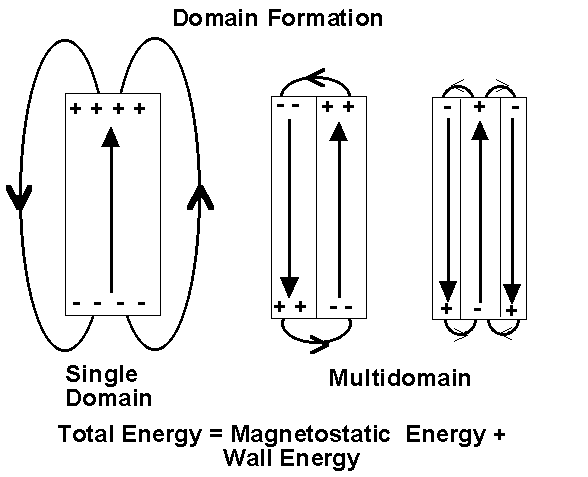
    (5) Now you have magnetic counters. But annoyingly enough, the polarity of the magnets is parallel to the surface of the strip, in tiny alternating mini-strips. This means that when you start to stack them on top of one another, they won't line up very well if they are cut from different magnetic sheets. For example, they might look like this:


    This also means that they tend to cancel out with one another, reducing the combined magnetic strength of the stack and making it less likely to stick to a steel surface. Instead, you want to repolarize each one to be a set of two perpendicular dipoles.

    The middle one is what we're after!
    So you want to remagnetize the counters using a stronger magnet. Buy a few rare-earth magnets (the ultra-powerful neodymium ones that come with safety warnings!) and stack them up to make a powerful paired dipole field. Make sure that you have two dipoles of opposite polarity, side by side, a little wider than your counter. The result should look like these:

    N.B.: Thanks to J. Walley for donating the magnets here.
    (6) Now place your magnets on top of the dipole stack, and they'll instantly remagnetize to the new polarity configuration (in a matter of seconds, with a strong field). Pull them directly off the stack vertically, not sideways through the field, or you'll overwrite the dipole moment during the brief period that the perpendicular alignment is lost.

    Generalissimo Chiang Kai-Shek: One of the worst HQs in the game.


    Best of all, this polarization is compatible with any of the old Shield Laminating counter clips that you might have lying around. So you integrate your new counters with any non-magnetic counters you need. Alas, these things seem to have gone out of production, so if you don't have one already you'll need to watch eBay and hope someone wants to part with a collection. They usually go for a substantial premium over the original price, and will easily set you out over $300 for a set large enough to play a monster game like World in Flames! By contrast, making your own magnetic counters for the same size game would cost under $50. (Granted, it's a lot of work!)

    (7) OK, now you're done! Just repeat this for the full set. You'll end up with a nice, neat stack of magnets. They can even be flipped over (along a lateral side, not the top/bottom) and will still stick, due to the double-dipole configuration!


    (8) Organize your stacks however you like! They'll stay in neat stacks that are easy to search through, rather than being a jumbled mess that you'll need to sort through every time you want to fish a particular one out.

    Before
    After


    They'll stack on a vertical surface up to about 16 high, using the magnetic strips I found. If you need to stack them higher or you want a high stack to be more stable during transportation, you can slip a couple of those rare-earths under the bottom of the stack, to intensify the field strength. Here's a stack of 20:


    Now rip the door off your refrigerator, tape a map to it, and you're all set! Or build your own game board by backing (magnetizable) steel sheets to a wooden panel.

    Wednesday, May 29, 2013

    MEK OP Game Night: Barbarossa Wrap

    We played through a second turn of the 5-turn Barbarossa campaign, but I decided to call it before the effort of production. The front was stalemating, which is to say that the Germans no longer had a serious chance of capturing any major objective

    In the continuing first turn, the Russians immediately launched an aggressive counterattack. Two stacks of Rumanians were pocketed and eliminated, resulting in a near collapse of Axis defenders. Poor weather forced a tactical retreat back across the border, sparing Rumania from a complete collapse.

    In the second turn, virtually all German attacks failed on low die rolls, aside from a couple that were at sufficiently poor odds that even victories didn't produce a spectacular outcome. By the third impulse, the Soviet forces were again counterattacking, and a single breach in the northern line was swiftly filled and repaired. Losses were very one-sided, with the Russians losing only a few divisions and weak infantry, and the Germans losing substantial quantities of armor and mechanized corps.

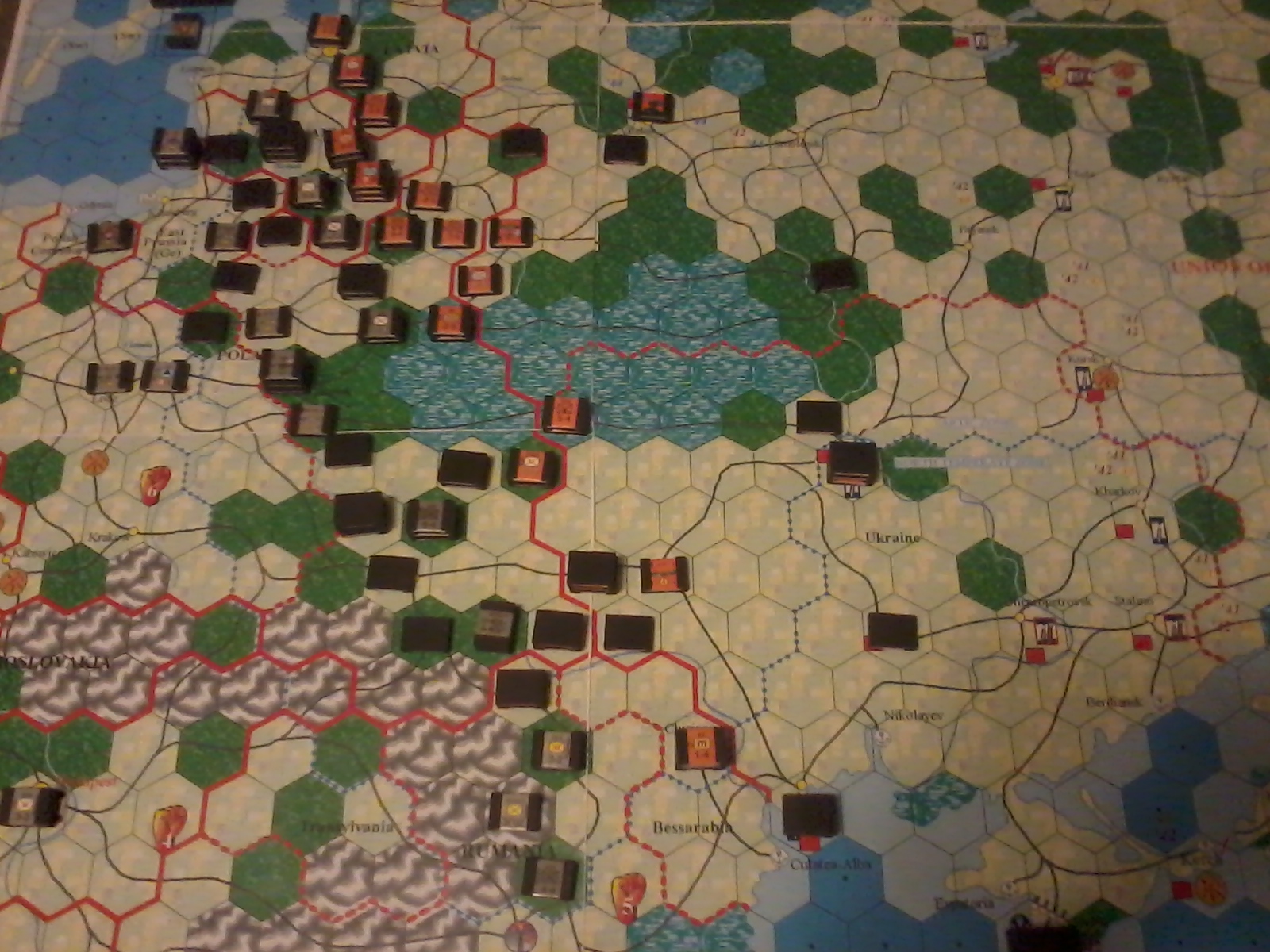
    Here's the board at the conclusion of the turn:


    The southern front is largely depopulated on both sides, and the north has a thickly stacked perimeter of tough corps bunkered behind river lines. Only the center still has some potential to open up for Germany, and even then, they've taken some meaningful losses.

    Final death tally: 14 to 4. The dice are set to the most common rolls for each side over the course of the night!

    Next week: Looking to find a third player, and switch to the Pacific map.


    Sunday, May 19, 2013

    MEK OP Games Night: WiF Barbarossa

    This weekend I set up the new World in Flames game for the first time, using newly laminated maps and my rather limited set of game counter magnets. I took the Russians, with the intent of letting the German player run through the initial super-combined move (via offensive chit) as a teaching tool. This effectively creates a turn impulse in which virtually every possible action that can occur, does occur.

    In some ways, pitting an inexperienced attacker versus an experienced defender doesn't do a great job of showcasing the system. For example, the primary power of the German Wehrmacht is in being able to quickly blitz through clear terrain and envelope enemy formations. But a clever Russian defender will simply set up in ways that place absolutely all the units in hexes with unfavorable terrain for blitzkrieg, forcing the Germans into making direct assaults with minimal penetration. Even with some decent rolls in the opening turn, the Germans were unable to obtain any exploitation results off the combat table, since all the vulnerable Russian units were set up in forests and cities.

    Here was the situation at the end of the first impulse:

    Army Group Centre has blown a hole through the line south of the Pripet Marshes that I'll need to repair, and the Rumanians have killed a quality MECH corps, but otherwise the Germans have only been able to blast away a few perimeter defenders.

    After another Axis impulse, the gap is still filled with a stopgap that should take a couple more impulses to clear, and every other Axis formation is disorganized and out of commission until July.


    The Germans have eliminated Timoshenko's HQ, at the cost of flipping. Some reserves are waiting to move forward and the Russians are probably going to fall back toward Kiev to shorten the line against a couple new German corps that have railed in to rescue Rumania.

    At this point we quit. Casualties were relatively even on both sides:


    Incidentally, both sides were understrength relative to a normal invasion due to some of my misunderstanding of the rules. The idea of calling out "reserves" is a new development since the 5th edition, and works differently for major powers and minor countries. For a minor country, they work more like normal production, although they build for free. For major powers, the materialize on the map instantly after a declaration of war, but just suffer disorganization. So the Russians should have gotten all their reserves immediately, giving them a lot more defenders.

    On the other hand, I neglected to mention that the Germans could align the doughty Finns (and comic-relief Hungarians), which would have given the Germans an even larger number of additional units than the Russians were missing. This let me avoid setting up anything along the Finnish border. So everything roughly balanced out!

    Monday, May 13, 2013

    WiF Optional Rules

    With ambitions for a summer WW2 campaign using the World in Flames Deluxe set, I've been pondering the use of a few optional rules beyond the ones included in the RAW. In particular, I'd like to make production less random; currently it just involves drawing counters blindly from the available force pool, which can result in oddities like the British accidentally building an Australian infantry just as the Germans are massing an invasion fleet! It's also difficult to draw units randomly when using magnetized counters, which make it impossible to use the old "shake 'em all up in your hands and draw" method.

    The first rule is from our old days at the Calvin Historical Simulations Club:
    What's in this stack?!?
    • Fog of War: The units in each stack of the board are normally concealed, except during combat by any units that cover them. Any other player may request to see only the top land unit, the top naval unit, the top air unit, and any stationary assets like fortifications or factories.
    The advantage of this rule is that is prevents excessively time-consuming calculation of pre-combat odds, and represents a realistic level of operational intelligence.

    The second rule, which I'm proposing for the first time, is intended to reduce production randomness:
    • Production Specialization: Sort units into force pools (and sub-pools) as usual. Any pool that contains only units that have no year-dates on the reverse side must build randomly, as usual. For any other pool, do the following.
      • If the pool contains units from only one year, the unit(s) to be built may be selected non-randomly by the builder.
      • If the pool contains units from more than one year, and a single unit from the pool is built, it may be selected non-randomly by the builder, but may not be from the most recent year.
      • If the pool contains units from more than one year, and multiple units from the pool are being built, then the first unit must be selected non-randomly from the earliest year available, but all subsequent units may be selected non-randomly from any year.
    That's a little more complicated to explain than the current rule, but it should be faster to apply it in practice. It avoids the horrendous ordeal of constantly having to sort out force pools at the end of each turn, or else buying a stack of extra game trays to keep them sorted. The logic behind this is that, if you are building just one bomber wing a turn, your Ministry of War Production isn't going to be nearly as proficient at designing good planes as it would be if it were cranking out a dozen bomber wings.

    There are a few weird side effects from this rule, like the fact that small powers like the Chinese will have to wait an extra year to build most of their top-end units. On the other hand, they'll get to avoid the indignity of having to build some completely obsolete junk, which helps to balance it out.

    Sunday, May 5, 2013

    Building A Magnetic Game Surface

    Pretty much any game with a high counter density is in constant danger of being instantly destroyed by an errant elbow brush, table-leg kick, or gust of wind. And never mind the curious 18 month-old child I currently have roaming the house. So I'm currently trying to build my own portable gaming panel with a magnetic surface, so I can do something like this:


    OK, I'm a long way from having anything that works this well, but I did put together a rudimentary approximation to the basic concept. Currently I have three 22-gauge metal plates, side by side, backed with a sheet of 11/32' plywood. That's not very sturdy, but it does have the merit of being something I can move by myself if necessary. That's the right size for both World in Flames maps at their usual scale, or for a single map if it's been double-sized as in the image above. I really need to buy a set of self-driving wood-screws to connect the plates more firmly to the wood. Currently they're just held on with duct tape and carpet tacks. (I tested this with two tiny screws I found around the house, and they work great.) I definitely should have bought a sturdier wood board, too, even at the cost of needing a second person to transport the game.

    Alas, the set of  400+ game counter magnets I own seems to have been stored improperly (too much heat? not aligned correctly during transport?) and the magnets no longer grip the metal as well as they should. The idea of turning the board vertically and mounting it on the wall seems to be out of the question. At the same time, they do snap together into useful stacks, and they don't slide around nearly as much as they would if they were free, so I still consider it an improvement over non-magnetic counters. At least I should be able to move it into a back room less accessible to toddler fingers and pedestrian traffic, in between sessions.

    If anyone has the slightest idea of where to buy the (apparently discontinued) 1/2" game counter tiles that used to be sold in a box that looks like this one, let me know. I see only a single instance of them being sold on Ebay within the last year, so the existing stockpile must be either dwindling or subject to hoarding. Looks like an economic opportunity for a magnetic-sheet manufacturer to exploit. Or maybe that's just wishful thinking, in an age where hex-and-counter games are virtual dinosaurs.