Showing posts with label Runebound. Show all posts

Saturday, September 7, 2013

MEK OP Game Night: Runebound

The first Saturday session of the semester had about 12 in attendance, with quite a few new faces. There were two big events: a Warhammer 40k scenario between Ork and Space Marine armies, and a 6-player Runebound. We also set up a couple of nights for RP sessions on Monday and Wednesday, which are going to be run independently of the main club meeting times.

2nd edition version: Even nastier!
The Warhammer game finished after about four rounds, in a fairly inconclusive draw. Everyone involved broke off to work on assembling the new Grey Knights set, which will probably be a multi-week project. Most of the glue work seems to be finished, but there's still an enormous amount of painting to be completed.

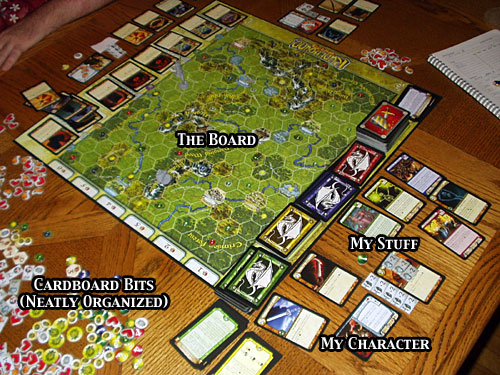
The Runebound game took about four hours, and ended with a fairly tight battle that resulted Dragon Highlord Margath on the first attempt. I think if we play again, we'll probably try incorporating a few 2nd edition rules, including the respawning of lower-level encounters. With that many players on the map, the endgame usually involves only a couple characters that are able to handle red-difficulty encounters.

My attempt to set up a WiF campaign seems to have mostly fizzled. I suppose there needs to be some kind of permanent culture already in place to support that style of game, and the current swing of the wargaming pendulum is pretty heavily in favor of both "miniatures" and "fantasy/SF themes". A historical hex-and-counter system is a hard sell.

I'll probably run a Space Empires: 4x game next week, which is the simplest strategic-scale hex-based game I have. It's similar enough to established computer games like Civilization and  (especially) GalCiv that it should feel familiar even on a first play-through. We obviously have a lot of new players to integrate into the routine. I might run it with no ground combat, just to make everything run a bit faster the first time through.

Personal notes

Currently the state of the Fantastic Frontiers rules draft document is too messy for me to feel comfortable shopping it around, but I might try to play through a couple selected playtests with people I can trust to be patient despite Enormous Glaring Problems. Removing EGPs is an immediate concern, so I can avoid coming off like a crank who wants everyone to play my half-baked vanity project at the expense of time that could be better spent moving around Ork motorcycles dripping with guns, chainsaws, and spiky bits.

Immediate priority: Finishing off some fantasy encounter tables with lots of classic monsters from my old D&D sourcebooks (MM1 &2, and the Cyclopedia).

Realization in which I take perverse pride: The two items in a classic monster stat bloc that virtually everyone ignored back in 1st edition ("% lair" and "Morale") end up being of critical importance in a skirmish-scale game with a persistent world map!

Sunday, April 28, 2013

MEK-OP Game Night: Final Exam Week!

Everyone was busy with the wrap-up of the semester (I'm giving an exam on Monday, Tuesday, and Wednesday), so we just spent a few hours playing through the first half of a Runebound game (1st edition). With six people the pace of the game is significantly slower, but I think everyone still had fun. We had to quit just as I had assembled a perfect combo of melee maces!

A few thoughts about the game:
  • Although the biggest changes from 1st to 2nd edition was the norming of the dice distribution (2d10 vs 1d20) and necessary tweaks to keep the game challenging, playing with this many players makes it absolutely essential to use regenerating encounters. That's a rule that should import pretty easily from 2nd edition without needing to use the 2e Adventure Card set.
  • The combat system is apparently more confusing to other people that I expected. I needed to explain it a few times before it made sense. It's very counterintuitive that "attacking" and "defending" use the same mechanic and can both cause damage to you after a failed check.
  • The movement system is still wonky to me, since it doesn't really reflect any simulationist attitude toward terrain difficulty. Walking along a road, for example, requires "road face" results -- which means that it's almost impossible to be allowed to walk along four consecutive roads instead of taking a mandatory detour through the nearby mountains! Whether this sort of thing bothers you or not is probably a signature of where you reside on the vertical GNS axis.
For my own purposes in designing an "exploration game" that involves some similar pseudo-RPGish elements, the aspect of this game that I'd most like to modify is the "downtime" issue. I don't want to completely eliminate downtime; it's actually an advantage in slow, strategic games that are left up over multiple sessions so that, for example, my wife can put my daughter to bed while the rest of us keep playing. But I do want to make it more optional, and create a role for players who are not active in the turn cycle.

Some ideas for how to keep off-turn players engaged in a multiplayer adventure board game:
  1. Group players into teams. I always prefer this approach to a free-for-fall once the number of players goes past three. In some games, even three players makes for too many sides to be stable in game-theoretic terms. (It's easy but rare for a two-player game to create an asymmetric equilibrium, but trivially easy to accomplish in an n-player game.) With good coordination, a team of players can complete certain portions of the game (like movement) simultaneously, speeding up the sequence of play.
  2. Give players an intervention mechanism that activates during other players' turns. In a free-for-all, this needs to be something that involves hostile interference: playing a "wandering monster" in Munchkin, say, or anything in the Dungeonlord phase of Dungeoneer. But in a team-based game, this could be a form of material support. I prefer the latter mechanism since it has simulationist precedent (Lend-Lease during WW2, for example), which avoids the question of "Why am I suddenly playing the bad guys now?" In some games, it might make thematic sense that the enemies could be influenced by agents of the other team.
  3. Segregate starting points. Instead of having all six players begin at the same location (which forces them to go one at a time in a race to valuable objectives/resources, etc), the players can then spend the early development portion of the game doing simultaneous movement. This works pretty well in 4x strategy games that involve exploration.
I'd recommend the first and the third ideas, but also apply the second idea sparingly. I can see some merit in having the game start with (3), and then transition toward emergent or preset alliances (1) and occasional cooperative interventions (2). But I appreciate a very small component of hostile intervention (2) to function as a wildcard, as long as it doesn't preclude effective strategic planning. Everyone deserves a healthy backstab now and then, right?

Friday, April 5, 2013

Game Review: Runebound

As an example of a game review, here's a write-up for Runebound, one of several wilderness exploration games I've collected as an example of the hexcrawl concept applied to a board game. Runebound had a troubled release cycle that left me with a bad taste in my mouth; the first edition of the game was replaced (within about a year) by an improved second edition, and then all expansion products were associated with the newer edition. This had the effect of sticking early purchasers (like me!) with an obsolete game. Still, the new edition has proven quite popular, with a half-dozen expansions released over the last decade.

Runebound

Number of Players: 1-4 (best with 1-2)
Year Released: 2004
Rule Book: 12 pages (in 3 column format)
Playing Time: 240 minutes
Mechanics: 1d20, roll-high, modify roll (changed to 2d10 for 2nd edition)
Rating: 7 out of 10

Description:
Runebound is a fantasy game with a theme inspired by modern role-playing games. Each player controls a single hero who wanders around a fixed board, slaying randomly generated monsters and accumulating treasures and allies. Exploration aspects of the game are minimal, and most rules relate to simulating combat. The game objective is to defeat a powerful dragon, either in battle or by collecting a specific set of items. A more detailed descriptive review may be found here.

Player Agency:
Runebound uses a movement system based on terrain, rolling a specified number of dice (4 to 5) in order to determine which types of terrain are possible to move through. This creates a puzzle component to movement, as each die face allows access to only certain types of terrain. Rare types of terrain result, like swamp, are less accessible. This creates the odd situation of standing right next to a hex and being unable to enter it, yet being able to run a long distance in a different direction. There are still usually a large number of options available, especially early in the game.

Combat is highly random (especially with 1d20 in the first edition), and there are few decisions to be made. Typically most characters have a choice between attacking with their "best" style of attack (mind, body, or spirit), or else making the earliest possible attack even if it might be weaker. This introduces some amount of tactical complexity. As extra allies are accumulated, the game acquires an element of resource management, with a frequent decision of whether to use powerful allies at the risk of losing them, or to hold them in reserve.

For the most part, each random event or encounter has a fixed outcome that can't be resolved in multiple ways. The wilderness always contains hostile enemies, and the villages always contain friendly allies and merchants.

Emergent Complexity:
Early in the game, each player has only a single character. As allies are gained, there are more choices to be made about how to use them. Otherwise, the game primarily gives harder versions of older enemies with improved attribute scores. In particular, encounters continue to involve only a single enemy at one time (sometimes glossed as a group in the description text), even as the hero gains new allies. The 2nd edition resolves this asymmetry by limiting the number of allies (or, as a variant, charging maintenance for them), but this reduces the emergence of complexity.

Most subsequent games follow the same pattern, with little variation between play sessions. Certain items can influence strategy, but there's really only one path to victory: the accumulation of greater battle prowess through experience, items, and allies. Distinct hero specializations (mind/body/spirit) result in mechanically identical implementations, and feel mostly cosmetic rather than altering strategy. This is characteristic of a modern game that avoids mechanical diversity at all costs. In that sense, this game is very much like an MMO (where physical and magical combat work about the same way) than a classic pen-and-paper RPG (where the magic system looks radically different from other play elements).

Verisimilitude:
The art style and naming conventions suggest a game intended to emulate comic book, action-oriented fantasy tropes. Heroes are slightly ridiculous, encouraging a lightly humorous approach. Virtually all mechanics are intended to present a world of heroic deeds, with no need to both about mundane items or practical exploration complications (like finding food or getting lost). The game does a good job of matching theme to mechanics, although the choice of theme itself might be criticized as being a bit too juvenile for "serious" gamers.

Certain aspects of the game seem to suggest theme elements that are never developed. For example, the dice system might represent the effect of getting lost and giving up to strike out in a different direction, and the process of getting "knocked out" in a battle and returning to a village might represent being the beneficiary of either a ransom or a rescue mission. The game booklet seems mostly disinterested in this kind of simulationist detail, electing instead to simply present arbitrary rules without comment.

Verdict:
This is a basic but high-quality thematic game. The development of the theme is consistent, if a bit cartoonish in flavor, and there are enough decisions to keep the player engaged. The level of rules complexity is appropriate for a short game with the need for limited introduction, but insufficient to create multiple paths to victory. Overall I regard this game as a bit too simplistic for heavy play, but it feels about right for an entry-quality game to the genre.

Somewhat problematically, it plays best with either 2 players or as a solo game due to the extended downtime between player turns. Yet the complexity level of the game rule booklet suggests it's intended mostly for a group or club that rotates between different games from week to week, as a lowest-common-denominator experience that won't intimidate inexperienced players. This is a persistent problem with RPG-clone boardgames which intentionally emulate a cooperative "player-versus-environment" style of play.

One of the best features of this game is the ability to leave a challenge encounter waiting on the board and return to it later. This creates some meaningful strategy choices, as assembling the correct combination of allies and items for a given opponent can involve careful planning. The movement system, however, encourages more of a random wanderer feel, rather than careful planning of a sequence of multiple turns. This sort of tension between design objectives and mechanics prevents this game from being as strong an experience as it might otherwise be.