Wednesday, April 17, 2013

Resource Management: Why You Need To Go Retro To Hex-Crawl

Today the retro-RPG community (organizing around Eric Tenkar's blog) has spontaneously organized a promotional campaign for the Swords and Wizardry system. For anyone not aware, S&W is a consolidation of various rules from the early days of D&D into a single unified rule book. Back in the 70s, most games were released in a piecemeal fashion through various supplements, expansions, and magazines, and so it's debatable whether there's even such thing as "classic 70s D&D rules", given the tendency of playing groups to pick and choose their own rules from a nebulous universe of such supplements and articles to create widely dissimilar experiences. But if such a thing had ever existed, it probably would have looked quite a bit like S&W does!

This put me in consideration of why the "dungeon game" (dungeon-crawling) has been so dominant in subsequent RPG products, while the "wilderness game" (hex-crawling) has virtually died. Here's my hypothesis.

Each game has an organic unit of resource management. For a classic RPG game (anything in the 70s, plus most of the "basic" line in the 80s), the organic unit was the adventure, which usually lasted for at least a day, and possibly as long as a week. Here are the resources that would slowly be whittled away over the course of the adventure in the classic era:
  • powers like the druid's shapechange;
  • spells, which (until the introduction of "portable spellbooks" in Unearthed Arcana, couldn't be rememorized anywhere except the home base;
  • consumables like food, torches, ammunition, oil, holy water, spikes, etc.;
  • hit points, which took forever to recover (maybe 1d3 points per rest-day, or something similar), and also the initial freedom from status impairments (like level drain); and
  • pets, hirelings, and henchmen, who tended to have very short life expectancies!
Now look at a modern RPG, or a computer game like World of Warcraft. Virtually all these resources have been eliminated, or allowed to replenish almost instantly. This results in a new game model where the organic unit of play isn't the adventure, but a single battle. At the end of the battle, resources like health, spells, etc, all get reset back to "full", and play continues.

A consequence of this is that there's little point in fighting anything but the toughest fights. The original purpose of random encounters (what computer RPG players call "trash") was to whittle down the party and create dramatic tension. Now they're just there to kill time and let people practice. In a computer game killing time is part of the point, but in a group session around a table, everyone's time is too precious. So the focus collapses onto a few "boss battles" and elaborate set pieces.

This basically kills the whole idea of exploring a huge, organic, realistic, sandbox-ish world. If the judge (DM, whatever) needs to prep those huge set-piece battles, then it's crucial to railroad players into those encounters and keep them from exploring anything else. This also creates a snowball effect where the game system keeps inventing cool combat-only powers/feats that further slow down the pace of those huge set-piece battles, making it necessary to invest more and more time in them and make them even more elaborate to justify the rules that support them.

Breaking out of the cycle requires everyone to give up their massive laundry-list of feat-based builds and revert to a simpler and faster style of combat. It also requires a reversion to the old "adventure-scale" resource management systems, rather than "battle-scale" resource management with full post-battle recovery. Although I see some indication that D&D Next is aware of the need to support both play styles, I'm afraid that when both exist at once, players will always gravitate toward the more-powerful feel of characters under the battle-unit model.

Hence the need for retro-clone versions of games from the classic era. It's no surprise that, of recent hex-crawl designers (like John Stater and Robert Conley), Swords and Wizardry has been the system of choice. Here's a big tip of the hat to Matt Finch for creating the omnibus rules book, and to all the folks who have supported S&W since then. The current publisher Frog God Games (which always releases dual product versions for both Pathfinder and S&W) is offering a one-day sale on their entire S&W line, and I can recommend any of Stater's Hex Crawl Chronicles as a good example of this play style. I've been consciously imitating his event description style while writing my own game events.

Monday, April 15, 2013

Source of the Nile: Fantasy Style

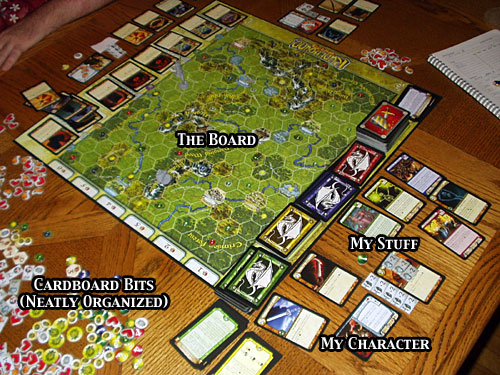
The set of hex-crawl board-game rules I wrote over last summer (tentatively titled "Fantastic Frontiers") might be regarded as a mash-up of three different game systems:
  • The wilderness exploration system of Avalon Hill's Outdoor Survival.
  • The expedition planning, discovery, and combat systems of Discovery Games' Source of the Nile (or Search for the Nile, depending on edition).
  • The character creation and encounter systems of the classic D&D's rules booklet Vol III: Underworld and Wilderness Adventures.

It's thus particularly interesting to note that several early articles on Source of the Nile were published in Dragon Magazine. Here's a list of all three articles:
  1. See Africa And Die!, by Gary Gygax: A set of proposed revisions and house rules, along with general praise for the game design. Many enthusiastic suggestions, although most of them are pretty minor. Some new bonuses are clearly intended to reduce lethality, and a system for more realistic population of tribes is given as a table. Also, a nice system for randomly generating tribe names.
  2. Search for the Nile Revisited, by David Weseley: A response to the first article by a SftN designer. He accurately notes that most of the proposed changes are trying to introduce more subjective role-playing elements into the game.
  3. Lost Civilizations, by Eric Holmes: Dr Holmes suggests adding a possible "forgotten city of Atlantis" encounter type, with a variety of random pulp-flavored features. Holme also recounts his own game, in which his intrepid explorer met with a series of complete disasters and barely escaped alive after discovering virtually nothing!
All of this is to suggest that the project of integrating an exploration/discovery game (with a distinctly historical flavor) and a fantasy adventure game was a very active area of interest in the late 1970s. I wonder why no one ever managed to follow up on that project? I'll keep working on my own mash-up, when I have time.
SOURCE OF THE NILE is a very fine game in its infancy. It needs further development, more illustrations and graphics, and better packaging. It is my sincere hope that the publisher will do well enough with it to eventually give it the treatment it deserves. Meanwhile, it is certainly worth buying in its current form, for it is a good game, and any future editions can make it a great game. - Gary Gygax

Monday, April 8, 2013

Classifying Methods of Randomization

Previously I compared some methods of randomly generating binary outcomes with dice. But of course there are non-binary contexts where dice can be useful as well. Roughly speaking, there are three ways to transform a dice roll into a result:
  1. Binary: Roll a result greater than (or less than) a given target to succeed. Usually also includes "equal to", so that the target value is the success-threshold rather than the failure-threshold.
  2. Spectrum: Roll a result, then look up the outcome of that result from a tabulated list of all possible outcomes, arranged in some ordinal schema (best to worst, etc).
  3. Hash: Also by reference to a table, but for outcomes that aren't (perhaps can't be) arranged in any meaningful order.
The boundary between a "spectrum" system and a "hash" system isn't always a sharp one, but roughly speaking, if the system is amenable to having a bonus or penalty applied to it (as a modifier) it probably counts as some kind of a spectrum. A true hash table result would be senseless to modify, since being adjacent to another item in a disordered hash table has no significance.

A major trend in games over the last couple decades has been the absolute decline of spectrum systems in favor of hash systems. Almost all complicated simulationist wargames still use spectrum tables (with a battle resulting in complicated combinations of losses, retreats, and other adverse effects), but most other board games and most RPGs have switched entirely to binary rolls for everything except "combat damage".

This bothers me enough that it sometimes intrudes on my ability to enjoy a game. I need a few spectrum results to make the game's theme feel "real" to me. Plus, there's something intrinsically exciting about a system that allows not just a success, but a critical success.

For example, early editions of D&D from the 70s had a ubiquitous "social roll" system that utilized a 2d6 spectrum as its common mechanic. Here are a few examples (courtesy of Brendan at Untimately):
Social Rolls
2d6 Negotiation Reaction Morale
2
Refused, -1 future
Attacks
Surrenders
3-5
Refused
Hostile
Flees
6-8
Will consider another offer
Uncertain
Fights, check again
9-11
Accepted
Friendly
Fights
12
Accepted, +1 future
Proactively helpful
Fights, no further check

Note that the system is intentionally open-ended. What does "hostile" mean? In an arbitrated game, that's for the judge (the DM, for D&D) to decide. A system like this is intended to encourage creativity and flexibility, adapting to the particular circumstance while retaining the thematic pattern of "bad to good outcomes, with a bell curve distribution". In effect, every time you see a table like this, the game is saying "you're making a social roll" -- as opposed to a combat roll, or an encounter table, or a skill check. Social interactions, by their nature, have lots of possible outcomes that make them much more interesting than a "can I jump across this pit?" binary system!

In the near future, I'm intended to use some spectrum mechanics for the intelligence and logistics systems in my Guadalcanal campaign hack of Naval Thunder. In the long term, I'd like to use the specific "social roll" system to build the social subsystems of my (work in progress) hex crawl game like negotiation and recruiting, helping to give it some "old school" flavor.

Sunday, April 7, 2013

Guadalcanal Campaign: US vs Japan

To take the tactical system from Naval Thunder and construct a strategic level game around it, I need to invent a few subsystems that generate the ships available for each battle. This involves creating the following:
  • A strategic-level movement system, handling movement on the scale of hundreds of miles (the south Pacific is BIG!), over a period of days.
  • A separate system for air movement and patrol, which occurs on a different time scale and involves "soft" zones of control where aircraft are dispersed over a large range of territory.
  • A search system, to figure out when task forces of ships can respond to one another's presences.
Additionally, it's important to appreciate the asymmetry between the Japanese situation in late 1942, and the American situation, since this needs a few subsystems of its own to be modeled. Roughly speaking, the USA is split between two theaters of war (and following a Hitler First strategy starting in North Africa) and mostly playing defense in the Pacific. The Japanese are focusing virtually all their military might on trying to isolate and strangle Australia and New Zealand, given the impracticality of invading distant (and heavily fortified) American objectives like Hawaii.

This leads to a very asymmetrical disposition of forces with the following advantages and disadvantages. Favoring the Japanese:
  • A larger navy in the Pacific theater, particularly in cruisers and destroyers. Initially Japan had a carrier-fleet edge, but frittered it away in the trap at Midway earlier in 1942.
  • Better field training and discipline, particular during night missions.
  • A superior grasp of certain tactics, like the use of torpedo runs.
Favoring the Americans:
  • A deeper pool of recruits, and particularly, the ability to constantly replace lost pilots.
  • A major intelligence advantage due to the cracking of all vital Japanese military codes.
  • Primitive (but rapidly improving) radar systems that could spot ships from 14 miles away.
  • Nearly unlimited fuel reserves, thanks to giant East Texas oilfields, and an extensive merchant marine that could be put into service as oilers and supply ships.
  • A better development of ground-based airfield resources, such as Henderson Field on Guadalcanal.
Note that while most of the Japanese advantages show up on the tactical level (and are built into the Naval Thunder rules), the American advantages are almost entirely strategic. Looking at force compositions, the advantages seem overwhelmingly to favor the Japanese. Looking at how those forces could actually be used, the odds are much more balanced.

At minimum, this suggests two more strategic-level subsystems:
  • A logistics system which forces the Japanese to leave many of their larger ships in harbor, aside from occasional sorties and offensive strikes.
  • An intelligence system, which allows the Americans to gain essential information about Japanese task force composition (but not vice versa).

Miniatures and the Game Industry

In my college days, the centerpiece activities of my game club's members were usually (1) massive, campaign-scale, 6-12 player wargames (World in Flames, Empires in Arms, Imperial Starfire) or (2) homebrew RPG campaigns. We did a few odds and ends with board and card games, but that was just filler. The priority was always on providing large-group social activities. This makes a certain amount of sense, since this is the one dynamic that computer games couldn't match. Of course, that was two decades ago, and now MMOs are stealing that portion of the market too.

What's left? Miniatures. I think they've survived for a few reasons. First, they can't be replaced by a computer, since so much of their appeal is based on tangibility. A computer rendering of a battlemech still can't quite eclipse the satisfaction that comes from actually moving a little model of your Atlas around a hex map. But more importantly, I think, it's the only remaining profit margin in the industry. Everything else has been replaced by pdfs, and in a world of bit-torrent pirates, pdfs are probably stolen instead of purchased, nine times out of ten. Minis can't be downloaded, so they're safe.

Recently I found this breakdown of sales components from a Friendly Local Game Shop owner. It's eye-opening. Miniatures (and accessories to customize them) make up something like 70 percent of all profits. RPGs are maybe another 25%, and everything else (card and board games) is just slivers. This is probably because collectibles are considerably more likely than other products to turn customers into "whales" who provide a reliable income stream, allowing stores (or publishers, or designers) to weather economic downturns. Other games are too faddish and cyclical, or involve making initial investments that don't prompt any need for further purchases.

In some sense all those games I played back in college were "too good", providing so much replay value for their price point that they could be played for years without needing to spend another dime. An RPG system, or a six-month-long wargame, will keep a creative group of players busy for a decade and free up their disposable income for other uses. That's great for players, but terrible for business.

Friday, April 5, 2013

Game Review: Runebound

As an example of a game review, here's a write-up for Runebound, one of several wilderness exploration games I've collected as an example of the hexcrawl concept applied to a board game. Runebound had a troubled release cycle that left me with a bad taste in my mouth; the first edition of the game was replaced (within about a year) by an improved second edition, and then all expansion products were associated with the newer edition. This had the effect of sticking early purchasers (like me!) with an obsolete game. Still, the new edition has proven quite popular, with a half-dozen expansions released over the last decade.

Runebound

Number of Players: 1-4 (best with 1-2)
Year Released: 2004
Rule Book: 12 pages (in 3 column format)
Playing Time: 240 minutes
Mechanics: 1d20, roll-high, modify roll (changed to 2d10 for 2nd edition)
Rating: 7 out of 10

Description:
Runebound is a fantasy game with a theme inspired by modern role-playing games. Each player controls a single hero who wanders around a fixed board, slaying randomly generated monsters and accumulating treasures and allies. Exploration aspects of the game are minimal, and most rules relate to simulating combat. The game objective is to defeat a powerful dragon, either in battle or by collecting a specific set of items. A more detailed descriptive review may be found here.

Player Agency:
Runebound uses a movement system based on terrain, rolling a specified number of dice (4 to 5) in order to determine which types of terrain are possible to move through. This creates a puzzle component to movement, as each die face allows access to only certain types of terrain. Rare types of terrain result, like swamp, are less accessible. This creates the odd situation of standing right next to a hex and being unable to enter it, yet being able to run a long distance in a different direction. There are still usually a large number of options available, especially early in the game.

Combat is highly random (especially with 1d20 in the first edition), and there are few decisions to be made. Typically most characters have a choice between attacking with their "best" style of attack (mind, body, or spirit), or else making the earliest possible attack even if it might be weaker. This introduces some amount of tactical complexity. As extra allies are accumulated, the game acquires an element of resource management, with a frequent decision of whether to use powerful allies at the risk of losing them, or to hold them in reserve.

For the most part, each random event or encounter has a fixed outcome that can't be resolved in multiple ways. The wilderness always contains hostile enemies, and the villages always contain friendly allies and merchants.

Emergent Complexity:
Early in the game, each player has only a single character. As allies are gained, there are more choices to be made about how to use them. Otherwise, the game primarily gives harder versions of older enemies with improved attribute scores. In particular, encounters continue to involve only a single enemy at one time (sometimes glossed as a group in the description text), even as the hero gains new allies. The 2nd edition resolves this asymmetry by limiting the number of allies (or, as a variant, charging maintenance for them), but this reduces the emergence of complexity.

Most subsequent games follow the same pattern, with little variation between play sessions. Certain items can influence strategy, but there's really only one path to victory: the accumulation of greater battle prowess through experience, items, and allies. Distinct hero specializations (mind/body/spirit) result in mechanically identical implementations, and feel mostly cosmetic rather than altering strategy. This is characteristic of a modern game that avoids mechanical diversity at all costs. In that sense, this game is very much like an MMO (where physical and magical combat work about the same way) than a classic pen-and-paper RPG (where the magic system looks radically different from other play elements).

Verisimilitude:
The art style and naming conventions suggest a game intended to emulate comic book, action-oriented fantasy tropes. Heroes are slightly ridiculous, encouraging a lightly humorous approach. Virtually all mechanics are intended to present a world of heroic deeds, with no need to both about mundane items or practical exploration complications (like finding food or getting lost). The game does a good job of matching theme to mechanics, although the choice of theme itself might be criticized as being a bit too juvenile for "serious" gamers.

Certain aspects of the game seem to suggest theme elements that are never developed. For example, the dice system might represent the effect of getting lost and giving up to strike out in a different direction, and the process of getting "knocked out" in a battle and returning to a village might represent being the beneficiary of either a ransom or a rescue mission. The game booklet seems mostly disinterested in this kind of simulationist detail, electing instead to simply present arbitrary rules without comment.

Verdict:
This is a basic but high-quality thematic game. The development of the theme is consistent, if a bit cartoonish in flavor, and there are enough decisions to keep the player engaged. The level of rules complexity is appropriate for a short game with the need for limited introduction, but insufficient to create multiple paths to victory. Overall I regard this game as a bit too simplistic for heavy play, but it feels about right for an entry-quality game to the genre.

Somewhat problematically, it plays best with either 2 players or as a solo game due to the extended downtime between player turns. Yet the complexity level of the game rule booklet suggests it's intended mostly for a group or club that rotates between different games from week to week, as a lowest-common-denominator experience that won't intimidate inexperienced players. This is a persistent problem with RPG-clone boardgames which intentionally emulate a cooperative "player-versus-environment" style of play.

One of the best features of this game is the ability to leave a challenge encounter waiting on the board and return to it later. This creates some meaningful strategy choices, as assembling the correct combination of allies and items for a given opponent can involve careful planning. The movement system, however, encourages more of a random wanderer feel, rather than careful planning of a sequence of multiple turns. This sort of tension between design objectives and mechanics prevents this game from being as strong an experience as it might otherwise be.


Next Playtest: Naval Thunder

For a very long time (dating back over 20 years to when I was in high school) I've wanted to play an operational level game showing naval warfare during the Guadalcanal campaign. I still have a mildewing notebook with extensive lists of planes, ships, and units that were intended for a design that I never had time to attempt. At this age, it probably makes more sense to find an existing game and create a scenario for it.

Why Guadalcanal? For a few reasons:
  • This is the last time in history when the USA was facing off against an opponent of roughly equal technological capability, with roughly balanced forces.
  • The personal confrontation between the doomed Japanese admiral Yamamoto and the tough-as-nails Bull Halsey created a sense of theatrical drama that is unusual for 20th century warfare, more akin to Grant and Lee in the Civil War. (Only Rommel might earn similar levels of sympathy and respect as a "noble foe".)
  • The flagships of each fleet, the IJN Yamato and the USS Enterprise, continue to enjoy an iconic status in the national mythology of each nation - to the extent that extensive science-fiction franchises have been built around futuristic incarnations of each ship!
Legendary Fleet Carrier USS Enterprise
Massive Super-Battleship IJN Yamato

 The ultimate showdown of carrier versus battleship:


 versus


My first attempt at finding a system will be a playtest of the Naval Thunder rules, for a single historical scenario in the Guadalcanal campaign (probably the 1st battle on Nov 11-12). This was a brutal knife-fight that left an American cruiser force largely wrecked, but also resulted in the first sinking of a Japanese battleship and set up the decisive American victory a few days later, when the US Navy's own battleships arrived on scene.

Ultimately I'd like to create a week-long campaign with a strategic-level map of the Solomons, allowing each side to create custom task forces and missions that differ from the historical composition. Maybe the Yamato and the Enterprise will finally meet one another in an epic confrontation of battleship brawn versus carrier finesse!